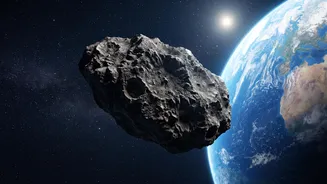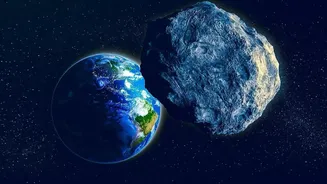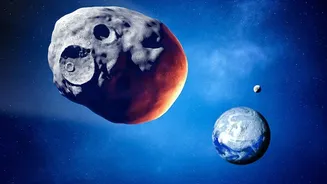


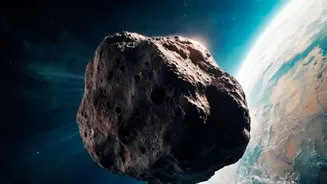

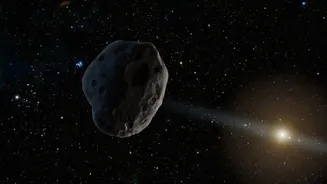
For billions of years, the Moon has been Earth’s steadfast celestial partner. But our planet is more promiscuous than you might think, occasionally snagging small asteroids that become temporary 'mini-moons' before wandering off again.
Earth's Unofficial Moons
A mini-moon, or
a Temporarily Captured Orbiter (TCO), is exactly what it sounds like: a small space rock captured by Earth's gravity. These objects, typically just a few metres across, are pulled from their own orbits around the Sun and fall into a temporary, often chaotic, orbit around our planet. Unlike our permanent Moon, these visitors don't stick around. A typical mini-moon might stay for several months, completing a few lopsided orbits before the complex gravitational dance between the Earth, Sun, and Moon flings it back into interplanetary space. While computer models suggest there should be at least one mini-moon orbiting Earth at any given time, their small size and speed make them incredibly difficult to spot. To date, only a handful have ever been confirmed by astronomers.
Meet Our Next Visitor: 2026 QQ8
The latest addition to this exclusive list of observed visitors is the asteroid designated 2026 QQ8. Its anticipated arrival offers a fresh chance for scientists to study this fleeting phenomenon up close. While every mini-moon provides a valuable data point, the ability to prepare for an object's capture in advance is particularly exciting. The discovery was announced after astronomers tracked its trajectory and realized it was on a path to be ensnared by Earth's gravitational field. Much like its predecessors—such as 2006 RH120 and 2020 CD3—2026 QQ8 is a small object, likely no bigger than a car. These previous visitors set the stage, proving that mini-moons were not just a theoretical concept and giving astronomers a better idea of what to look for.
The Delicate Dance of Capture
How does a planet catch a moon, even a temporary one? It's a matter of cosmic timing and delicate physics. An asteroid must approach Earth at a relatively low velocity and at just the right angle to be captured. It's a bit like threading a needle in space. If it comes in too fast, it will shoot past us. Too slow or at the wrong angle, and it might plunge into the atmosphere as a meteor. The capture process often happens near gravitational balance points, known as Lagrange points, where the pull of the Sun and Earth are in a delicate equilibrium. An asteroid wandering through one of these regions can be nudged from its solar path into a looping, unstable orbit around Earth. This chaotic orbit is why their stays are so short; the same gravitational tug-of-war that captures them eventually pushes them away.
A Window Into The Solar System
For scientists, mini-moons are more than just a novelty; they are pristine samples of the early solar system delivered right to our doorstep. Because these small asteroids are too small to have undergone significant geological changes, they are essentially time capsules. Studying them provides clues about the composition and formation of planets. Furthermore, they are much easier and cheaper to study than asteroids in the main belt between Mars and Jupiter. A mission to a mini-moon would be significantly shorter and require less fuel. This makes them perfect testbeds for future asteroid exploration technologies, including potential mining operations or planetary defense strategies. By analyzing the light reflected off 2026 QQ8, scientists hope to determine its composition, which could range from a solid block of rock to a loose pile of rubble. Some studies even suggest recent mini-moons may be pieces of our own Moon, blasted off by ancient impacts.
A Fleeting but Valuable Companion
Observatories around the world will be tracking 2026 QQ8 as it makes its journey through our neighbourhood. Each observation helps refine our understanding of how planetary systems interact with smaller bodies. Surveys like the Catalina Sky Survey and the upcoming Large Synoptic Survey Telescope (LSST) are making it increasingly likely that we'll find more of these temporary visitors in the coming years. While 2026 QQ8 is too small to be seen with the naked eye, its brief time as Earth's second moon is a powerful reminder of the dynamic and ever-changing nature of our solar system. It highlights that the space around our planet is not empty but a busy thoroughfare of ancient rocks, each carrying secrets about the history of our cosmic home.