



The Allure of the Super-Earth
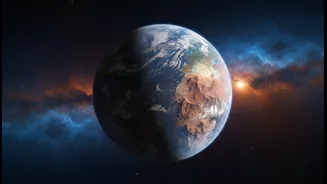
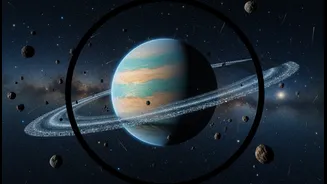
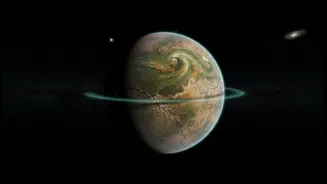
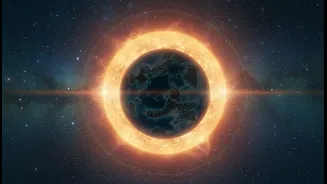
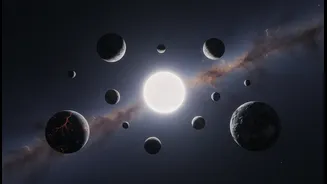
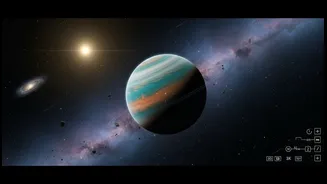
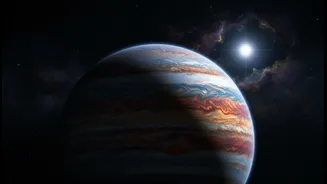
First, let's clear up a common misconception. A “super-Earth” isn't necessarily a bigger, better version of our own planet. The term refers only to a planet’s mass and size—larger than Earth but smaller than Neptune. They are a class of planet we don't
have in our own solar system, yet they appear to be incredibly common throughout the galaxy. Some are rocky, some may be 'water worlds', and others could be dense gas planets known as mini-Neptunes. Their diversity is exactly what makes them so thrilling for astronomers. Finding them is a key part of the search for worlds beyond our own, a cosmic game of sorting through countless possibilities to find a planet that might, just might, be like ours. A recent example that has generated buzz is GJ 3378b, a super-Earth about 25 light-years away that seems to be in the 'just right' zone of its star.
Decoding the Signal From Light-Years Away
Most exoplanets are found using the “transit method.” Imagine watching a distant, bright lightbulb. If a moth flies in front of it, the light will dim slightly. Astronomers detect exoplanets by measuring a similar, tiny dip in a star's brightness as a planet passes in front of it. This initial detection is a monumental achievement, but it only gives us basic information: how big the planet is and how long it takes to orbit its star. While this data helps determine if the planet is in the so-called “habitable zone”—the orbital range where temperatures could allow for liquid water—it says nothing about whether water actually exists, or if the world is a barren rock, a gas giant, or something else entirely. The headlines often jump the gun, but the science is just getting started.
The All-Important Atmosphere Caveat
This is where the real detective work begins, and it’s incredibly difficult. The key to habitability as we know it is a planet’s atmosphere. It provides breathable air, shields the surface from harmful radiation, traps heat to maintain stable temperatures, and is essential for a water cycle. To find out if a super-Earth has one, scientists use advanced tools like the James Webb Space Telescope (JWST) to perform what's called transmission spectroscopy. As the planet transits, a tiny fraction of the starlight filters through its atmosphere. Different gases absorb light at specific wavelengths, leaving a chemical fingerprint that the telescope can read. But the signal is minuscule and hard to interpret. As one astronomer put it, it's like trying to detect the effect of a moth's swimsuit as it flies past a lightbulb 20 kilometers away. Furthermore, what seems like a detection of a certain gas can sometimes be an artifact of incomplete models.
Science vs. Science Fiction
This is the critical gap every reader should understand. A planet being in the “habitable zone” does not make it habitable. Venus and Mars are in or near our sun's habitable zone, but one is a scorching greenhouse and the other is a frigid, irradiated desert. The discovery of a planet like GJ 3378b is tantalizing because it gets about the same amount of light as Earth does from the sun. But without knowing if it has a protective atmosphere, its location is just a promising starting point. For now, scientists can't confirm if GJ 3378b even has an atmosphere, let alone one that could support life. The media often blurs the line between “potentially habitable” (a technical term about orbital distance) and “inhabited” (a science-fiction dream).
How to Read Beyond the Hype
So, how can you stay informed without getting misled? Look for the caveats. When you see a headline about a new Earth-like planet, scan the article for key phrases. Do the scientists mention confirming an atmosphere? Are they using cautious words like “may,” “could,” or “potential candidate”? Do they explicitly state that they haven't detected an atmosphere yet? A good science report will celebrate the discovery while being honest about the immense challenges and unanswered questions that remain. These discoveries are genuinely wonderful, representing incredible feats of human ingenuity. The excitement is real and justified. Empowering yourself with a little knowledge makes the journey even more rewarding, allowing you to separate the confirmed facts from the hopeful speculation.