



A Cosmic Message Received
In a breakthrough for astrophysics, scientists have identified a specific galaxy as a source of high-energy neutrinos, some of the most mysterious particles in the universe. After a decade of painstaking observation, researchers at the IceCube Neutrino
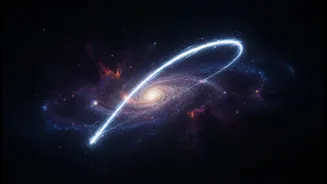
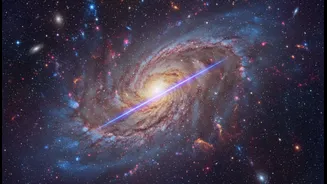
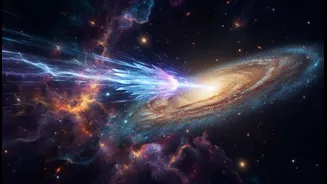
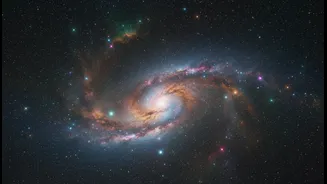
Observatory in Antarctica traced a steady stream of these particles back to a galaxy known as NGC 1068. Located 47 million light-years away, this galaxy is a powerhouse of cosmic activity, and for the first time, we have clear evidence linking such a place to the production of these ghostly messengers. This is only the second time a specific, distant source of high-energy neutrinos has ever been confirmed, marking a major milestone in our quest to understand the most violent events in the cosmos.
The Elusive 'Ghost Particle'
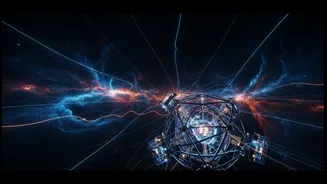
So, what exactly is a neutrino? Often called 'ghost particles', neutrinos are fundamental particles that have almost no mass and no electrical charge. This means they barely interact with anything. Billions of them from the Sun are passing through your body every second without you ever noticing. While this makes them incredibly difficult to detect, it’s also their superpower. Unlike light or charged particles, which can be blocked by dust or deflected by magnetic fields, neutrinos travel across the universe in a straight line from their source, completely unimpeded. They are pristine messengers, carrying secrets from the heart of cosmic engines that are otherwise completely hidden from our telescopes. Detecting them requires massive experiments, like the cubic kilometre of Antarctic ice used by IceCube.
Inside a Stellar Factory
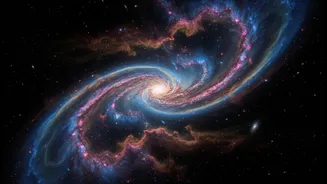
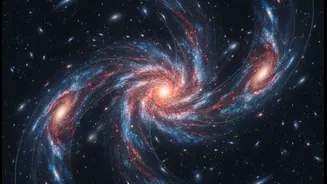
The source of these particular neutrinos, NGC 1068, is what’s known as a 'starburst galaxy'. Imagine a galaxy where new stars are being born at a rate hundreds of times faster than in our own Milky Way. This frantic pace of star formation creates an incredibly turbulent and energetic environment. These galaxies are often the result of cosmic collisions, filled with massive, short-lived stars that explode into powerful supernovae. At the heart of NGC 1068 is also an active supermassive black hole, which is gobbling up surrounding gas and dust, creating an intensely bright and chaotic region known as an active galactic nucleus (AGN). This combination of rapid star birth and a hungry black hole makes the galaxy a perfect candidate for a natural particle accelerator.
Peering into the 'Shadow'
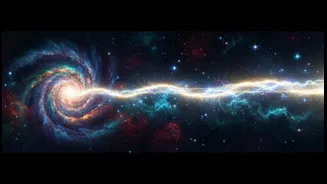
The name 'Shadow Blaster' captures the most exciting aspect of this discovery. While NGC 1068 is incredibly bright, its core is shrouded in a thick veil of gas and dust. This cosmic fog traps most high-energy light, like gamma rays, that is produced within. If we only used traditional telescopes, the galaxy's central engine would be almost completely obscured—hidden in shadow. But neutrinos, with their ghostly ability to pass through matter, escape this cosmic shroud. They 'blast' out of the core, carrying direct information about the processes happening deep inside. The fact that IceCube detected neutrinos from NGC 1068, while gamma-ray telescopes saw very little, confirms that neutrinos can give us a unique view into these hidden corners of the universe, a view that no other messenger can provide.
A New Era of Astronomy
Pinpointing a source for high-energy neutrinos is about more than just one galaxy. It helps solve a century-old puzzle about the origin of cosmic rays—high-energy particles that constantly rain down on Earth but whose sources have remained a mystery. The same violent processes that create cosmic rays are also thought to create neutrinos. By finding a neutrino factory, we have likely also found a cosmic ray factory. This discovery firmly establishes the field of neutrino astronomy. By combining information from neutrinos with observations from light, gravitational waves, and other cosmic signals, we are entering a new era of 'multi-messenger astronomy', where we can build a much more complete picture of the universe's most extreme events.