


A New Window to the Dawn of Time
The James Webb Space Telescope (JWST) is not just a more powerful telescope; it's a time machine. By capturing infrared light, which can travel across billions of light-years without being scattered by cosmic dust, Webb allows us to see the universe as
it was just a few hundred million years after the Big Bang. For years, theories and computer models have predicted what these first galaxies would look like. The consensus was that they would be small, messy, and chaotic, still in the throes of a disorderly assembly. These early images were expected to show clumpy, irregular blobs of gas and stars, slowly crashing together over billions of years to form the grand, structured galaxies we see in our cosmic neighbourhood today. Webb’s powerful new images, however, are painting a very different and far more surprising picture.
Unexpected Order in the Primordial Universe
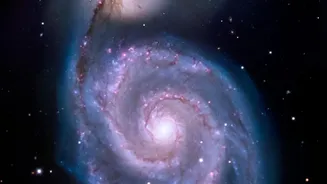
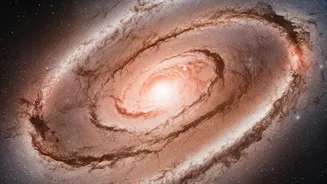
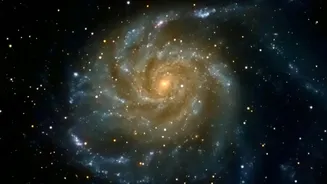
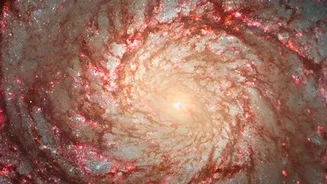
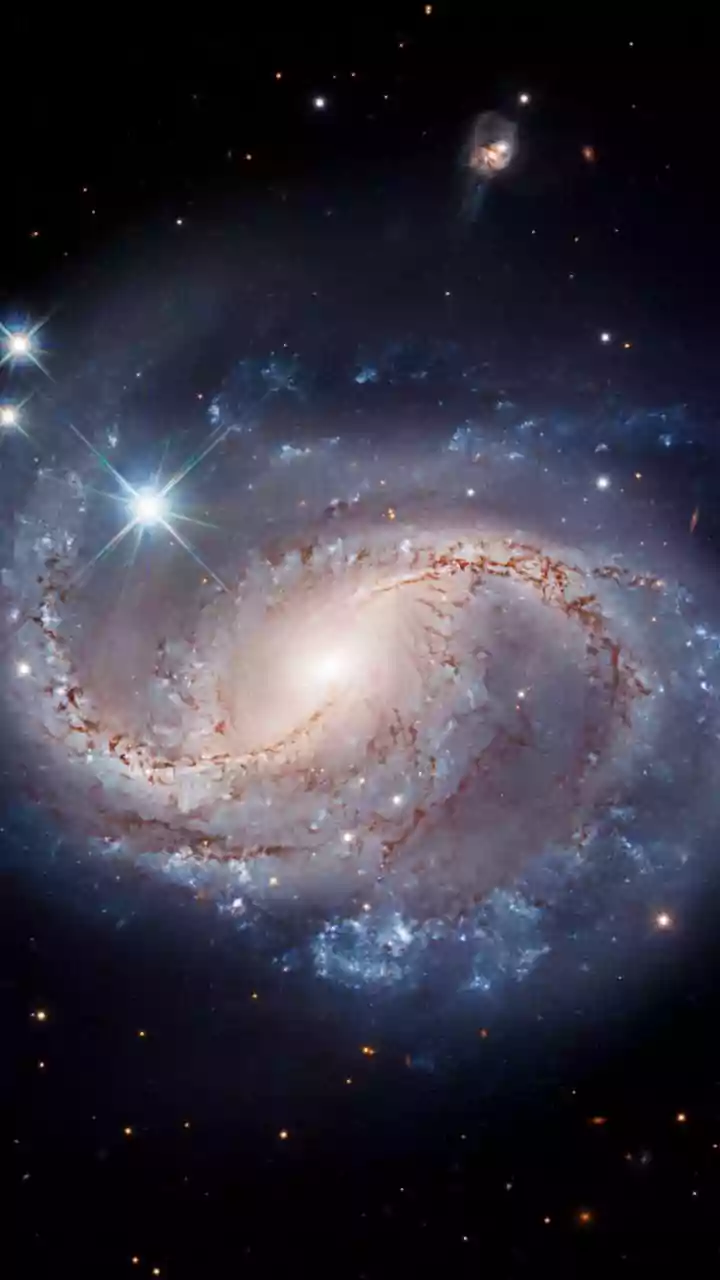
The biggest surprise from Webb's deep-field observations is how mature many of these ancient galaxies appear. Instead of the anticipated chaotic messes, astronomers are finding galaxies with a remarkable degree of structure far earlier than any model predicted possible. One stunning example, discovered by Indian researchers and nicknamed Alaknanda, is a well-formed spiral galaxy that existed just 1.5 billion years after the Big Bang. It has clear, symmetric arms curling out from a bright centre, much like our own Milky Way. Finding such a large, well-organised galaxy so early in cosmic history is a profound challenge to long-held theories of galaxy formation, which suggested such structures should take many billions of years to develop.
Upending the Cosmic Timeline
This discovery of 'settled' galaxies forces a major rethink of how quickly the universe got organised. The current standard model of cosmology traces everything back to the Big Bang about 13.8 billion years ago, followed by a period of rapid expansion and cooling. It was thought that gravity then slowly gathered enormous clouds of gas to ignite the first stars and galaxies. But Webb's observations suggest this process happened with startling efficiency. Galaxies appear to have been forming stars and developing heavier elements—which astronomers call 'metals'—much earlier and more abundantly than models had suggested. This doesn't necessarily mean the age of the universe is wrong, but it does imply that the early chapters of cosmic history unfolded differently, and perhaps much faster, than we ever imagined.
The Mystery of the 'Little Red Dots'
Alongside mature spirals, Webb is uncovering other strange phenomena. Among the most intriguing are objects nicknamed 'Little Red Dots' or LRDs. Hundreds of these distant, compact red sources have been identified in Webb's deep surveys. Astronomers are working to understand what they are, with leading theories suggesting they could be primordial galaxies hosting unusually active supermassive black holes that formed shockingly early in cosmic time. The presence of so many massive black holes in the infant universe is another major puzzle that scientists are now scrambling to solve, as it challenges our understanding of how these cosmic giants grow.
A New Era of Cosmic Questions
Far from providing final answers, the powerful new images from the James Webb Space Telescope have thrown open the doors to a new era of cosmic questioning. Each stunning image of a surprisingly mature galaxy or a mysterious Little Red Dot chips away at old assumptions. Scientists are now tasked with refining their models to account for this accelerated evolution. How did spiral arms form so quickly? How did supermassive black holes grow so large, so soon after the Big Bang? These are the exciting new puzzles that will drive the next decade of astronomy, all sparked by the revolutionary data Webb is sending back to Earth.