


A Library Made of Ice
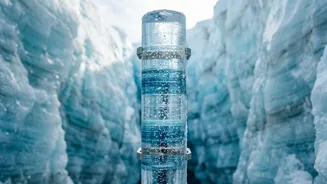
Imagine a library where the books are made of ice, and each page is a year of snowfall. That’s essentially what an ice core is. In places like Antarctica and Greenland, it’s so cold that the snow that falls never melts. Each year, new layers of snow fall on
top of the old ones, creating a timeline that can stretch back hundreds of thousands, or even millions, of years. Over time, the immense weight of the overlying snow compresses the deeper layers into solid ice. Scientists use specialized drills to extract long cylinders of this ice, some over three kilometres long, bringing this frozen archive to the surface for study.
Trapping Ancient Time Capsules
The magic of ice cores lies in what gets trapped between the snowflakes. As snow accumulates, the air from that time fills the spaces between the snow crystals. As the snow gets buried deeper and turns into dense ice, these pockets of air are sealed off, forming tiny bubbles. These bubbles are literally time capsules, each containing a minuscule, pristine sample of the Earth's atmosphere from the moment it was trapped. This process happens at depths of around 60 to 100 metres, meaning the air inside is slightly younger than the ice surrounding it, a factor that scientists carefully account for in their calculations.
Reading the Atmospheric Record
Once an ice core is retrieved, the analysis begins in a lab. To measure the composition of the ancient air, scientists carefully melt or crush the ice in a vacuum chamber, releasing the trapped gases. Using sophisticated instruments like laser spectrometers, they can precisely measure the concentrations of key greenhouse gases like carbon dioxide (CO2), methane, and nitrous oxide. This process allows them to reconstruct a detailed history of the atmosphere, showing how its composition has changed over vast timescales. These measurements have revealed the natural cycles of greenhouse gases over ice ages and have starkly highlighted the unprecedented spike since the Industrial Revolution.
Direct Evidence vs. Indirect Clues
The headline's claim of 'direct measurement' is what makes ice cores the gold standard in paleoclimatology. Many other methods for studying past climates rely on 'proxy data'—indirect clues. For example, tree rings can tell us about growing conditions, and sediment layers can reveal types of pollen, but they don't measure the atmosphere itself. Ice cores are different because the air bubbles are not a proxy; they are an actual, physical sample of the ancient atmosphere. While scientists also study the ice itself for proxies of past temperature (using water isotopes), the ability to directly measure atmospheric gases is unique and provides an unparalleled level of certainty.
Unlocking Earth's Climate Secrets
Thanks to ice cores, we have a continuous record of our planet's atmosphere going back at least 800,000 years from continuous cores, with some samples reaching as far back as 2 million years. This data has been fundamental to our understanding of Earth's climate system. It provided the first concrete proof that atmospheric CO2 and global temperatures are closely linked over long timescales. The data clearly shows that for hundreds of thousands of years, CO2 levels naturally fluctuated between about 180 and 300 parts per million. Today's levels, which are well over 400 parts per million, are far outside that natural range, providing definitive evidence of humanity's impact on the atmosphere.