






Your Eyes Are a Time Machine
It sounds like science fiction, but it’s one of the most fundamental and beautiful truths of our universe. Light, as fast as it is, takes time to travel across the vast emptiness of space. The Sun’s light takes about eight minutes to reach us, meaning
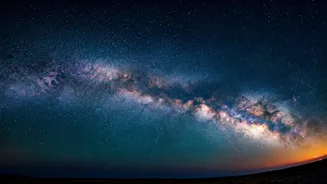
if the Sun were to vanish, we wouldn’t know for eight minutes. Now, apply that same logic to the stars. The nearest star system, Alpha Centauri, is over four light-years away. The light you see from it tonight left when you were four years younger. For more distant stars, this delay stretches from decades to centuries, and even millennia. Every star in the night sky is a ghost of its former self, showing you not what it is, but what it was. This turns every act of stargazing into an act of historical observation. You are, quite literally, looking at history.
Gazing into the Mughal Empire
Let’s start with a star many in India can find: Dhruva Tara, or Polaris, the North Star. It’s not the brightest star, but its fixed position has made it a guide for travellers for centuries. Polaris is approximately 433 light-years away from Earth. This means the light you see from it tonight began its journey around the year 1591. What was happening in India then? The Mughal Empire was near its zenith under the rule of Akbar. The grand city of Fatehpur Sikri had recently been the capital, and architects were perfecting the blend of Persian, Turkic, and Indian styles that would define Mughal aesthetics. While poets composed verses in royal courts and trade flourished, a single photon of light left the surface of Polaris. It travelled across the cosmos for over four centuries, past nebulae and asteroid fields, only to end its journey in your retina tonight. When you look at the North Star, you are seeing the same light that shone down on the age of Akbar.
Witnessing the Delhi Sultanate
Now, find the brilliant constellation of Orion, the Hunter, known in Indian astronomy as Kalpurush. One of its brightest stars is the blue-white supergiant Rigel, which marks the hunter's left foot. Rigel is a staggering 860 light-years away. The light from Rigel that reaches us today started its cosmic voyage around the year 1164 CE. At that time, India was a very different place. The powerful Chola dynasty still held sway in the south, but the north was on the cusp of monumental change. The Ghurid dynasty from Afghanistan was beginning its invasions, events that would lead to the defeat of Prithviraj Chauhan and the establishment of the Delhi Sultanate just a few decades later. The light you see from Rigel is a silent witness to the end of one era and the violent birth of another. It’s a photon from a world of Rajput kings and impending conquest.
Light from the Age of Buddha
For a truly profound leap back in time, locate the constellation Cygnus, the Swan. Its tail is marked by the brilliant star Deneb. Deneb is so luminous that it shines brightly in our sky despite being one of the most distant stars visible to the naked eye. Its distance is estimated to be around 2,600 light-years. The starlight you see from Deneb tonight left its surface around 600 BCE. This is an incredible historical touchpoint. This light is a contemporary of ancient India’s great spiritual awakening. It began its journey when Mahavira was developing the tenets of Jainism and Siddhartha Gautama, the Buddha, was teaching the Four Noble Truths. The Mahajanapadas, the 16 great kingdoms of ancient India, flourished. While thinkers in the Gangetic plains debated the nature of existence, Deneb released this light. It is, in essence, ancient history, delivered fresh to your eyes.