







A Science Lab for an Alien World
Set to launch no earlier than 2028, Dragonfly is one of the most ambitious planetary science missions ever conceived. Its destination is Titan, Saturn’s largest moon, a world shrouded in a thick, nitrogen-rich atmosphere where liquid methane rivers carve
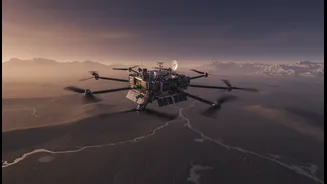
channels into a landscape of water ice. Scientists believe Titan’s complex chemistry could resemble that of early Earth, making it a prime target in the search for the building blocks of life. Managed by the Johns Hopkins Applied Physics Laboratory (APL), the mission will send a dual-quadcopter, or octocopter, to this alien world. Unlike stationary landers or slow-moving rovers, Dragonfly will be able to fly from one promising location to another, covering dozens of miles in a series of “leapfrog” flights. Its goal is to sample and analyze materials from diverse geographic settings, from sand dunes made of organic solids to the floor of an impact crater where liquid water may have once mixed with these complex organics.
The Challenge of Flying on Titan
Flying on Titan presents a unique set of engineering paradoxes. In some ways, it's easier than flying on Earth. The moon’s atmosphere is four times denser than our own, and its gravity is only about one-seventh as strong. This combination provides significantly more aerodynamic lift, making it possible for a heavy vehicle like Dragonfly to achieve flight. However, the environmental conditions are punishing. Temperatures on the surface hover around a frigid minus 179 degrees Celsius. The vehicle’s sensitive electronics and scientific instruments must be protected from this extreme cold while also shedding the heat generated by its nuclear power source. The lander's design must withstand the violent vibrations of launch, the multi-year cruise through deep space, and a fiery, two-hour descent through Titan's atmosphere before it even begins its first flight.
Clearing Major Engineering Hurdles
This summer, the Dragonfly team announced it had cleared a series of critical tests, transforming the rotorcraft from a collection of blueprints into a tangible, space-bound vehicle. In late June 2026, the APL team completed structural testing on the lander’s nearly 13-foot-long fuselage, delivering it ahead of schedule for the next phase of assembly. Throughout May and June, the team conducted extensive vibration and sealing tests. The lander frame, fitted with mass simulators to stand in for its future instruments, was shaken to ensure it could withstand the loads of launch and landing. Sealing tests were also performed to confirm the craft can protect its internal systems and maintain its required internal temperature in Titan’s deep freeze. These successes follow earlier tests of the craft's heat shield material, which was subjected to temperatures of nearly 2,500 degrees Celsius to prove it can survive atmospheric entry.
From Lab Simulation to Titan Reality
Passing these ground tests is a monumental achievement that significantly de-risks the mission. Each successful test gives NASA confidence that the design is sound and that the spacecraft can survive its long journey and operate in its challenging destination. With the structural frame now verified, engineers have begun the intricate process of installing Dragonfly’s ‘nervous system’—its wiring harnesses, cables, and connectors. Soon, they will integrate the flight electronics, avionics, and the sophisticated suite of science instruments that will hunt for chemical clues on Titan’s surface. Every component, from the high-gain antenna that will send data back to Earth to the rotors that will lift it into the alien sky, is being meticulously built and tested. This progress keeps the mission firmly on track for its planned 2028 launch aboard a SpaceX Falcon Heavy rocket.