



The Sun's Turbulent Outbursts
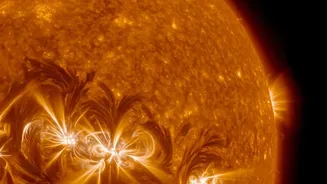
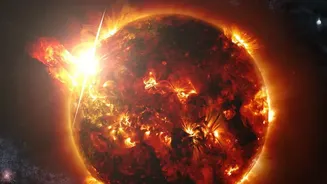
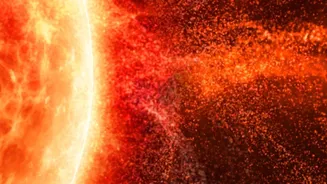
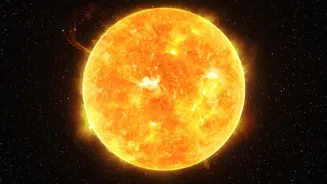
The Sun, the life-giving star at the center of our solar system, is not always benign. It has a dynamic and often violent nature, characterized by powerful eruptions. The most significant of these are solar flares and coronal mass ejections (CMEs). A
solar flare is an intense burst of radiation that reaches Earth in just eight minutes. A CME, often associated with a flare, is a massive cloud of magnetised plasma and radiation hurled into space, taking one to three days to reach Earth. These phenomena, collectively known as space weather, are driven by the Sun's complex magnetic fields. While they produce the beautiful auroras, they also pose a significant threat to our increasingly tech-dependent civilization.
An Invisible Shield with an Achilles' Heel
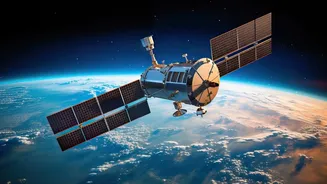
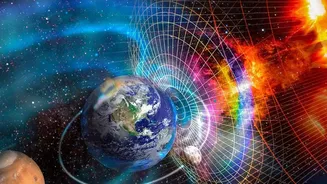
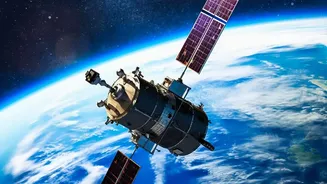
Earth has a natural defense, its magnetic field (or magnetosphere), which deflects most of the harmful solar particles. However, a powerful CME can compress and disturb this shield, triggering a geomagnetic storm. Such storms can have devastating consequences. They can induce powerful electrical currents in power grids, leading to widespread blackouts like the one in Quebec in 1989. They disrupt high-frequency radio communications and can cause GPS systems to provide inaccurate data by altering the signal's path through the atmosphere. For satellites, the danger is even more acute. The radiation can damage sensitive electronics, and the heating of the upper atmosphere increases drag, potentially causing satellites to fall out of orbit. In February 2022, a relatively minor storm led to the loss of 40 new Starlink satellites.
Coronagraphs: Our Eyes on the Sun
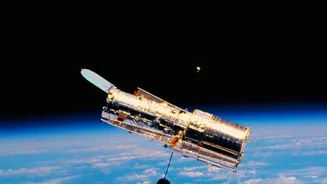
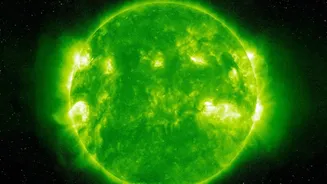
To protect our infrastructure, we need advance warning. This is where coronagraphs come in. A coronagraph is a special telescopic instrument designed to block the overwhelming glare of the Sun's bright disk, allowing scientists to see the much fainter outer atmosphere, the corona. It's like creating an artificial eclipse. By observing the corona, scientists can spot the tell-tale signs of a developing CME and issue warnings. Satellite-based coronagraphs are particularly effective because they operate above Earth's light-scattering atmosphere, providing a clear, continuous view. This real-time imagery is essential for space weather forecasters to predict the arrival and intensity of geomagnetic storms.
India's Aditya-L1: A New Sentinel in Space
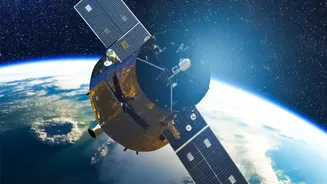
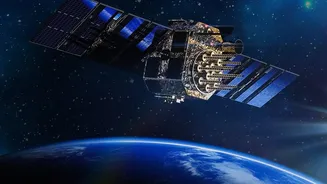
India has firmly established its presence in the global effort to monitor space weather with the Aditya-L1 mission. Launched by ISRO, it is India's first dedicated solar observatory. Positioned 1.5 million kilometers from Earth at Lagrange point 1 (L1), it has an uninterrupted view of the Sun. Its primary payload is the Visible Emission Line Coronagraph (VELC), a state-of-the-art instrument developed by the Indian Institute of Astrophysics. VELC is designed to study the origin of CMEs and the dynamics of the solar corona, providing crucial data for understanding and forecasting space weather. The mission's other instruments also monitor solar flares and the solar wind, making Aditya-L1 a comprehensive sentinel for observing the Sun's activity and its impact on Earth. Recent studies using Aditya-L1 data have already provided new insights into how solar storms interact with Earth's magnetic field.
Forecasting for a Secure Future
As our reliance on satellite technology for communication, finance, and defence grows, so does our vulnerability to space weather. The work of missions like Aditya-L1 and other international observatories is not merely academic; it is a critical component of our global infrastructure's security. By providing timely warnings, these coronagraphs and solar observatories allow satellite operators to take protective measures, such as temporarily shutting down sensitive components or adjusting orbits. Power grid managers can prepare their systems to handle induced currents, and aviation can reroute flights to avoid communication blackouts and radiation risks. In an age dominated by digital and space-based assets, these eyes on the Sun are the sentinels safeguarding the very foundation of modern life.