


A Glimpse into Our Sun’s Future
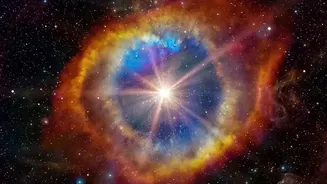
Located about 650 light-years away in the constellation Aquarius, the Helix Nebula is what’s known as a planetary nebula. The name is a bit of a misnomer; it has nothing to do with planets. Instead, it’s the spectacular, glowing remnant of a star, much
like our own Sun, in its final death throes. As the star ran out of fuel, it shed its outer layers of gas, which expanded into space. At its center lies a tiny, super-hot white dwarf—the star’s leftover core. This structure offers astronomers a preview of what our own solar system might look like in about five billion years. Because of its relative closeness to Earth, it has become a favorite laboratory for studying the end of a star's life.
The Decades-Old Mystery of the Knots
For years, images from telescopes like Hubble have shown that the Helix Nebula is filled with thousands of peculiar structures dubbed “cometary knots.” They get their name from their appearance: dense, glowing heads with long, streaming tails that point away from the central star. But these aren't comets. Each knot is a massive globule of gas and dust. The heads alone can be twice the size of our entire solar system, with tails stretching for 100 billion miles. The big question for scientists has been how these delicate-looking structures formed and, more importantly, how they survive the intense radiation and powerful stellar winds blasting from the dying star at the nebula's core.
Webb’s Infrared Superpower
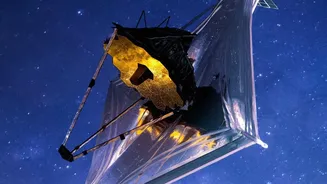
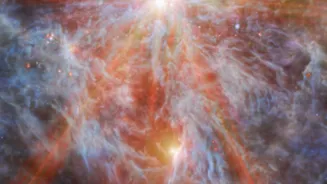
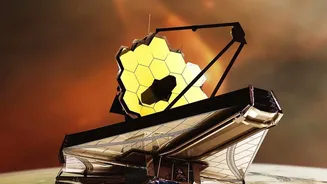
This is where the James Webb Space Telescope changes the game. While previous telescopes observed the nebula primarily in visible and ultraviolet light, Webb sees the universe in infrared. This allows it to peer through obscuring layers of gas and dust and detect the faint heat glow of cooler molecules. The new image, captured by Webb’s Near-Infrared Camera (NIRCam), provides the clearest and most detailed infrared view of the nebula ever obtained. It brings the enigmatic knots to the forefront, showing their structure in breathtaking resolution and revealing chemical details that were previously invisible.
A Puzzle Finally Coming into Focus
Webb's observations reveal that the knots are not just simple clumps; they are complex structures surrounded by cooler molecular hydrogen. This molecular gas acts as a protective shield, helping to insulate the dense knots from the harsh ultraviolet radiation of the central star. The new data shows a clear transition from the hot, ionized gas closest to the star to the cooler, molecular gas farther out where the knots thrive. This confirms theories that the knots are dense, resilient pockets of material that were likely ejected from the star earlier in its life and have so far withstood the violent environment of the expanding nebula. Webb's imagery essentially captures these knots being sculpted and eroded in real-time by the fierce stellar winds, offering a live look at how a star's recycled material is processed before returning to the cosmos to form future stars and planets.