







The Economics of Deep Sleep
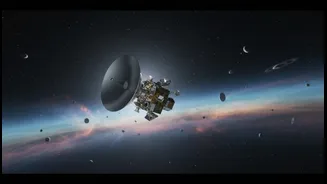
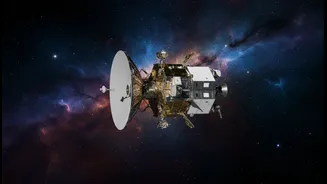
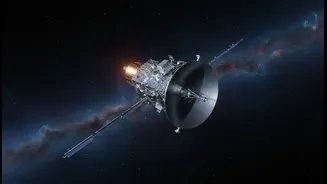
Why put a multi-billion-dollar spacecraft to sleep in the first place? For long-haul missions like New Horizons, hibernation is a critical cost-saving and life-extending strategy. Launched in 2006, the probe’s primary power source, a radioisotope thermoelectric
generator, has a finite lifespan. By powering down non-essential systems for long cruise periods, mission managers at the Johns Hopkins Applied Physics Laboratory (APL) conserve precious energy. This practice not only saves power but also reduces wear and tear on the spacecraft’s sensitive electronic components, mitigating the risk of failure over its decades-long voyage. Hibernation periods, which can last for many months, dramatically lower the costs of mission operations, as the probe requires minimal supervision. During this quiet phase, it enters a stable, slow spin, with its main computer simply monitoring its health and sending a weekly 'all clear' beacon back to Earth.
A Signal From the Edge of the System
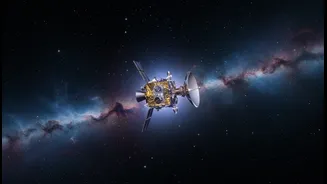
Waking New Horizons is a testament to precision and patience. The wake-up command isn't a last-minute decision; it was uploaded to the spacecraft’s computer nearly a year in advance. Acting on these stored instructions, the probe began its revival sequence in late June 2026. Given its staggering distance of roughly 9.5 billion kilometres from Earth, the confirmation signal, traveling at the speed of light, took almost nine hours to reach the anxious flight controllers via NASA's Deep Space Network. The first packets of data to arrive are always focused on the spacecraft's health and safety. Engineers at APL meticulously check the status of all systems to ensure the probe survived its long, cold nap in good health before proceeding. According to mission operations manager Alice Bowman, every weekly status report during the latest hibernation was 'green,' indicating all was well.
A New Mission in the Outer Darkness
While the stunning 2015 flyby of Pluto and the 2019 encounter with the Kuiper Belt Object (KBO) Arrokoth are its most famous achievements, New Horizons’ work is far from over. Its mission has now evolved. Its primary role is to serve as a unique deep-space observatory, collecting data on a region no other active mission can reach. Even while hibernating, key instruments like its plasma and dust detectors remained active, continuously sampling the environment of the distant Kuiper Belt. Now fully awake, the science team will begin downloading this treasure trove of information. The probe will also use its ultraviolet spectrograph to study hydrogen distribution in the outer heliosphere—the vast magnetic bubble the sun creates around the solar system. This data is crucial for understanding the boundary where our sun's influence ends and interstellar space begins, providing insights that even the legendary Voyager probes couldn't capture with their older instruments.
Is Another Flyby on the Horizon?
The tantalizing question remains: will New Horizons visit another distant world up close? The possibility is still on the table. While the mission's focus has officially shifted to heliophysics, NASA has ensured that it preserves enough fuel and operational capability for another flyby, should a suitable target be found. Finding that target is an immense challenge. It must be a KBO located within a very narrow cone of space ahead of the spacecraft's trajectory, reachable with its limited fuel budget. Astronomers continue to scan the heavens with powerful telescopes in hopes of identifying such a candidate before the spacecraft travels beyond the Kuiper Belt entirely, an event expected around 2028 or 2029. Until then, the spacecraft's powerful LORRI camera will be used for long-distance observations of other KBOs, studying them in ways impossible from Earth.