

The Promise of an Ocean World
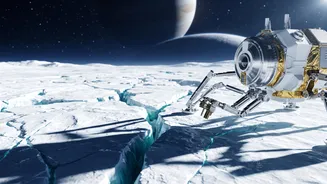
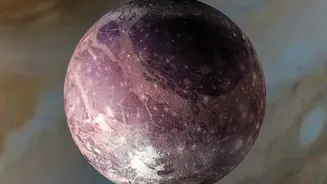
Europa has captivated scientists for decades. Roughly the size of Earth's moon, its surface is a chaotic landscape of fractures and ridges, hinting at a dynamic world beneath. The most compelling evidence for a subsurface ocean comes from data gathered
by the Galileo spacecraft in the 1990s, which detected a distorted magnetic field around the moon. This anomaly is best explained by the presence of a global, electrically conductive layer—like a massive body of salt water. This ocean is estimated to hold more than twice the water of all of Earth's oceans combined. The implications are staggering: where there is liquid water, energy, and the right chemical ingredients, there is the potential for life. This makes Europa a primary target in our cosmic search for habitable environments beyond Earth.
Peering Through the Ice with Radar
The most direct way to confirm and characterise this ocean is to look right through the ice shell. Missions like NASA’s Europa Clipper are equipped with a powerful ice-penetrating radar instrument called REASON (Radar for Europa Assessment and Sounding: Ocean to Near-surface). Think of it as a planetary-scale ultrasound. The instrument sends radio waves downward; these waves pass through ice but bounce back when they hit a boundary between different materials, like from ice to liquid water. By measuring the time it takes for these echoes to return, scientists can map the thickness of the ice shell, which could be anywhere from a few kilometres to over 30 kilometres deep. This radar can also spot pockets of water trapped within the ice, which could be crucial pathways for transporting chemical nutrients from the irradiated surface down to the ocean below.
Following the Magnetic Fingerprint
Another ingenious method involves magnetometry. Jupiter has an immense magnetic field that washes over Europa. As Jupiter rotates, its magnetic field fluctuates from Europa's perspective. If a conductive, salty ocean exists, this changing magnetic field will induce its own, secondary magnetic field within the ocean. Probes like Europa Clipper and the European Space Agency's JUICE (JUpiter ICy moons Explorer) carry sensitive magnetometers designed to detect this faint, induced field. By carefully measuring this magnetic signature during multiple flybys, scientists can not only confirm the ocean's existence but also estimate its depth and conductivity, which tells them how salty it is. This is a clever way of using physics to sense something that cannot be seen.
Searching for Geysers in Space
What if Europa is actively venting its ocean into space? Observations from the Hubble Space Telescope have suggested the presence of water vapour plumes erupting from Europa’s surface, similar to those famously seen on Saturn's moon Enceladus. While subsequent observations have been inconclusive, the possibility remains a key focus for upcoming missions. Spacecraft are equipped with instruments called spectrometers and mass spectrometers to 'taste' the particles in any plumes they might fly through. Instruments like MASPEX on Europa Clipper can analyse the chemical makeup of these gases, searching for salts, organic molecules, and other clues about the composition of the hidden ocean below. A dust analyser can also scoop up particles ejected from the surface to reveal the chemistry of their source. Finding a plume connected to the subsurface ocean would offer a direct sample without ever needing to drill through the ice.
A Symphony of Instruments
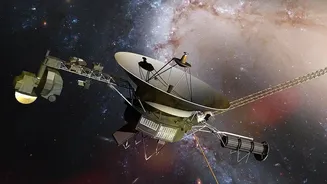
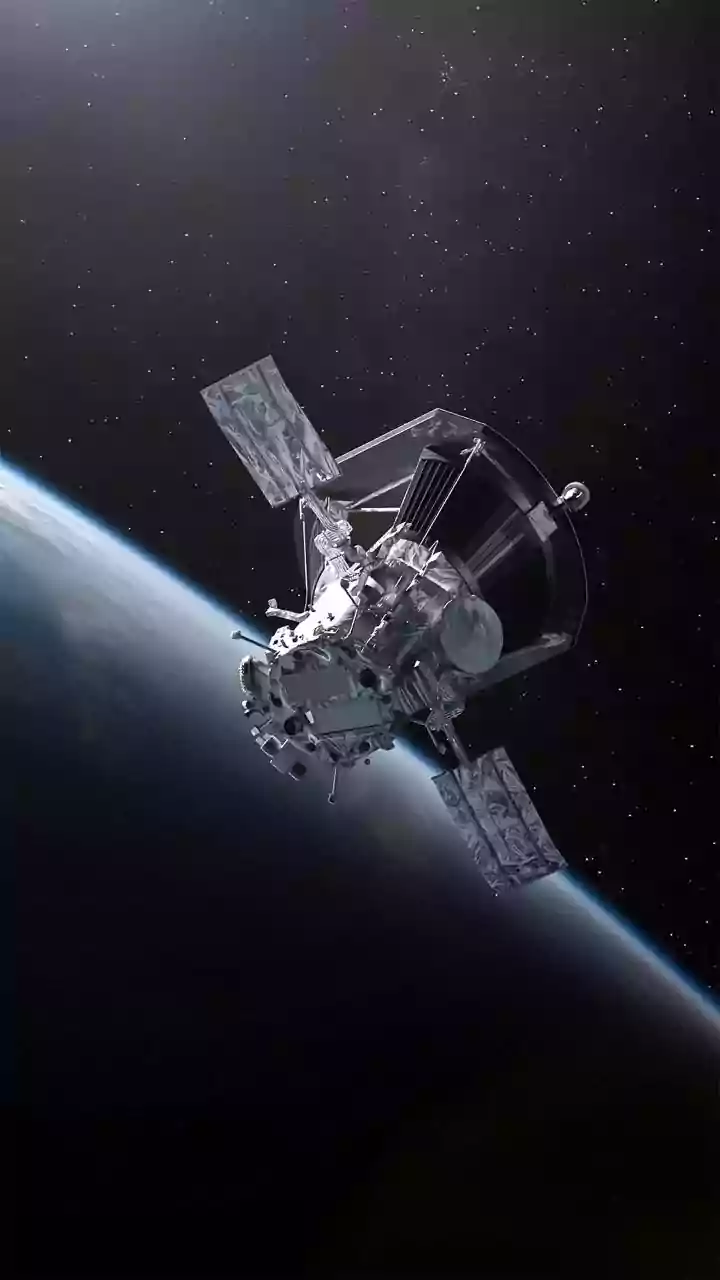
No single measurement can solve the puzzle of Europa. The strength of modern space probes lies in their suite of complementary instruments. While radar and magnetometers probe the deep interior, other tools map the surface. High-resolution cameras will chart the geology, thermal imagers will search for warm spots where the ice is thin, and gravity science experiments will measure how the moon's shape flexes under Jupiter's pull, offering another way to gauge the ice shell's properties. Data from all these instruments will be pieced together to build a comprehensive picture of Europa as a complex, dynamic world. This multi-faceted approach transforms the mission from a simple search for water into a detailed investigation of a potential habitat.