

Train Your Eyes for the Darkness
Jumping straight from a lit room to hunting for a faint nebula is like trying to read a book in a dark theatre without letting your eyes adjust. The human eye needs time for a process called dark adaptation, where it switches from using its colour-sensing
'cone' cells to its more light-sensitive 'rod' cells. This vital process takes around 20 to 30 minutes, and it is the key to unlocking the sky's faintest details. Starting your session by observing bright, easy-to-find objects allows your eyes to adapt naturally. This simple act of patience transforms the sky from a sparse collection of dots into a rich, detailed canvas. Any exposure to bright white light, like a phone screen or a car's headlights, can instantly reset your night vision, forcing the clock on dark adaptation to start all over again.
Your Celestial Starting Lineup
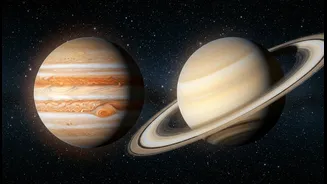
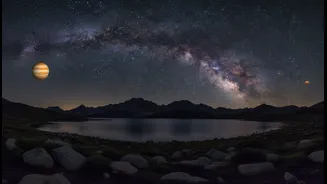
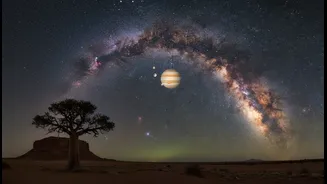
The best way to begin is with the night's most obvious celebrities. For observers in July 2026, the sky offers a brilliant welcoming committee. Venus, the brightest planet, is a dazzling beacon in the western sky shortly after sunset all month long. Early in the month, you might also catch a glimpse of bright Jupiter sinking toward the western horizon. For those staying up later or waking up early, Saturn will be visible rising in the east around midnight, while reddish Mars appears in the pre-dawn sky. Beyond the planets, look for prominent star patterns. The Summer Triangle, composed of the brilliant stars Vega, Deneb, and Altair, is high in the eastern sky during July evenings and is unmistakable once you learn to spot it. Finding these bright anchors not only helps your eyes adjust but also builds your confidence and sense of direction.
Connecting the Dots with Star Hopping
Once you have located a few bright stars, you can use them as celestial signposts to navigate to fainter targets. This technique is called 'star hopping'. Instead of pointing a telescope randomly, you start at a known bright star and follow a path of dimmer stars to your destination. Think of it as using a cosmic connect-the-dots map. For example, the two stars at the end of the Big Dipper's bowl always point toward Polaris, the North Star. In a similar way, you can use the stars of a constellation to hop your way to a nearby star cluster or nebula. This method is not only effective but also deeply rewarding, as it teaches you the layout of the constellations and makes you an active participant in your celestial treasure hunt.
The Leap to Fainter Wonders
After 20 to 30 minutes of enjoying the bright stars and planets, your eyes will be ready for a greater challenge. Now is the time to hunt for deep-sky objects (DSOs). These are objects outside our solar system, such as star clusters, nebulae, and galaxies. For beginners, a great first target is the Hercules Globular Cluster (M13), a dense ball of stars that can be found by star hopping from the bright star Vega. Another spectacular sight is the Andromeda Galaxy (M31), the closest major galaxy to our own. On a clear, dark night, it can be spotted with the naked eye as a faint, fuzzy patch of light. Even with binoculars, these objects begin to reveal their structure, offering a breathtaking glimpse into the vastness of the cosmos.
Tools That Enhance the View
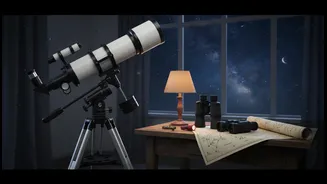
While this strategy works perfectly for naked-eye observing, a few simple tools can elevate the experience. A pair of binoculars is arguably the best first instrument for any budding astronomer, revealing countless stars and making objects like the Andromeda Galaxy and the Pleiades star cluster pop. When using charts or apps, make sure they have a 'red light mode'. Red light is far less damaging to your dark-adapted eyes than white or blue light, allowing you to consult your guides without compromising your vision. The goal is to work with your eyes, not against them, preserving that precious sensitivity you spent time building.