




The Great Cosmic Data Deluge
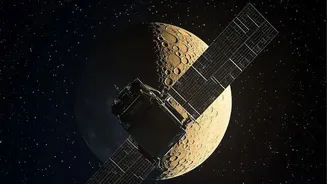
Modern space missions are victims of their own success. Probes like the Mars rovers and advanced space telescopes are equipped with incredibly sensitive instruments capable of generating terabytes of high-resolution imagery and scientific readings every
single day. For context, Earth observation satellites alone can generate over 100 petabytes—that's 100 million gigabytes—of data daily. This explosion of information is fantastic for science, but it creates a monumental logistical problem. Getting all of that data from a spacecraft millions of kilometres away back to a server on Earth is far from simple.
The Downlink Bottleneck
The primary issue is something engineers call the 'downlink bottleneck'. Spacecraft communicate with Earth using radio waves via networks like NASA's Deep Space Network. However, this connection has limited bandwidth, much like a rural internet connection compared to city fibre. The further a probe travels, the weaker the signal and the slower the data rate. This means transmitting vast datasets can take hours, days, or even weeks. During this time, the spacecraft might be collecting even more data, creating an ever-growing backlog. Sending everything is simply not feasible; it's inefficient and wastes precious mission time. A lot of the data collected can also be redundant or low-value, such as blurry images or readings of empty space.
Enter Onboard AI: The Smart Filter
This is where onboard Artificial Intelligence, a form of 'edge computing', becomes a game-changer. Instead of blindly transmitting every byte of raw data, a spacecraft equipped with AI can analyse information as it's collected. Think of it like a smart filter for your phone's camera roll that automatically deletes blurry photos. In space, this AI can sift through data to identify the most scientifically valuable parts. For an Earth-observation satellite, this might mean autonomously discarding images completely obscured by clouds. For a mission exploring one of Jupiter's moons, it could mean prioritising an image showing a potential water plume over thousands of pictures of plain ice. This ensures that the limited downlink bandwidth is used only for the most crucial discoveries.
More Than Just Filtering Data
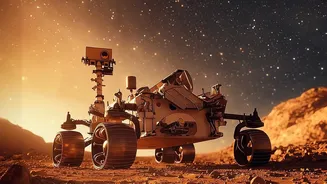
The importance of onboard AI extends far beyond just data prioritisation. Its most powerful application is enabling autonomy. For missions to distant planets like Mars, there's a significant time lag in communications. A command sent from Earth can take over 20 minutes to reach a rover. Waiting for instructions is not just slow, it’s risky. AI allows a spacecraft to make its own decisions in real-time. For example, NASA's Perseverance rover on Mars uses AI to navigate the terrain, identifying and avoiding obstacles on its own. This has allowed it to drive far more efficiently and safely on terrain never before seen by human eyes. This autonomous capability is essential for exploring dynamic or hazardous environments where immediate reactions are necessary.
The Future of Autonomous Exploration
Looking ahead, onboard AI will be less of a helpful feature and more of a core necessity for ambitious exploration. Future missions to the outer solar system, where communication delays are hours long, will rely on AI to conduct science independently. A probe could be programmed with scientific goals and then use its own intelligence to decide how to achieve them—identifying a scientifically interesting rock formation and choosing to analyse it without human intervention. The European Space Agency's Hera mission, for example, will use AI to navigate autonomously as it approaches an asteroid, similar to how a self-driving car operates. This shift transforms spacecraft from passive data collectors into active, intelligent explorers, capable of reacting to unexpected events and making discoveries in real-time.