






Crafting the Rulebook
Before any electric Vertical Take-Off and Landing (eVTOL) aircraft can carry passengers in India, a comprehensive regulatory framework must be in place. The Directorate General of Civil Aviation (DGCA) is the primary body responsible for this monumental
task. In 2024 and 2025, the DGCA released crucial guidelines for certifying the airworthiness of these new-age aircraft and for the design of 'vertiports'—the mini-airports they will use. However, this is just the beginning. A complete rulebook involves creating new pilot licensing categories, setting specific safety standards for a vehicle that operates somewhere between a helicopter and a fixed-wing plane, and establishing clear operational procedures. The Ministry of Civil Aviation (MoCA) is expected to finalize a national policy for Urban Air Mobility (UAM), which will set the overarching strategy for routes and state government coordination. This multi-layered approval process is complex and essential for ensuring safety.
Building the Ground Infrastructure
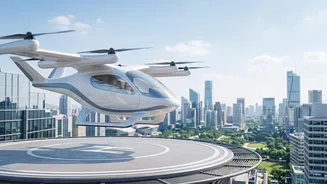
Air taxis don't need runways, but they can't land just anywhere. They require a network of vertiports, which are essentially sophisticated launch and landing pads equipped with charging stations, passenger handling areas, and safety equipment. Building this infrastructure is a massive challenge. It requires significant investment, land acquisition in already crowded cities, and integration with existing transport hubs like metro stations and airports. Companies like InterGlobe Enterprises, the parent of IndiGo, have partnered with US-based Archer Aviation with plans to not only operate up to 200 aircraft but also to help finance and build this critical vertiport infrastructure. The Airports Authority of India (AAI) has already earmarked potential sites in Delhi NCR, Mumbai, and Bengaluru for priority development, but turning these plans into a functional network across the country will be a slow and expensive process.
Ensuring Safety and Managing Airspace
Safety is the single most important hurdle. Regulators must ensure that eVTOLs are structurally sound and can operate safely in India's demanding climate, which includes extreme heat and monsoon conditions. The DGCA is aligning its technical requirements with global standards set by bodies like the FAA in the US and EASA in Europe, mandating fail-safe designs where an aircraft can land safely even if a motor or battery module fails. Beyond the aircraft itself, managing the skies will become more complex. A new Unmanned Aircraft Traffic Management (UTM) system will be needed to work alongside existing air traffic control. This digital platform must de-conflict the flight paths of numerous low-flying air taxis, drones, and traditional aircraft to prevent mid-air incidents, a challenge that requires significant technological and logistical planning.
The Affordability Question
For air taxis to revolutionize daily commutes, they must be more than a luxury for the ultra-rich. While early services will likely be priced at a premium, the long-term goal for operators is to become cost-competitive with ground-based taxi services. For example, a trip from Connaught Place to Gurugram, which takes 60-90 minutes by car, could take just seven minutes by air taxi. Companies like Sarla Aviation are aiming for fares around ₹2,000-₹3,000 for short city hops, believing this is the sweet spot for widespread adoption. Achieving this price point depends on manufacturing the aircraft and their components locally to avoid import duties, scaling up operations, and advances in battery technology, which remains the most expensive part of an eVTOL.
Winning Public Trust
The final piece of the puzzle is public acceptance. People need to feel safe stepping into a pilot-optional, battery-powered aircraft. This involves overcoming concerns about noise, visual pollution, and the safety of autonomous flight systems. Operators and regulators will need to be transparent about safety protocols and conduct extensive public awareness campaigns to build trust. Early use cases might focus on less controversial applications like air ambulances or connecting airports to city centers, as planned by Blade India and others. By demonstrating reliability and a strong safety record in these initial phases, the industry can gradually win the confidence of the broader public and pave the way for a true urban air mobility revolution.