


The Building Blocks of Life, Found in Space
When scientists talk about 'organic molecules' in space, they don't necessarily mean life itself. They're referring to carbon-based compounds that are the essential precursors to biology as we know it. These include molecules like amino acids, which form
proteins, and nucleobases, which are components of DNA and RNA. For decades, researchers have found these compounds within meteorites that have crashed on Earth, providing strong evidence that these building blocks are synthesized in extraterrestrial environments. The discovery proves that the raw materials for life are not exclusively terrestrial but are, in fact, cosmic in origin.
From Cosmic Clouds to Rocky Caravans
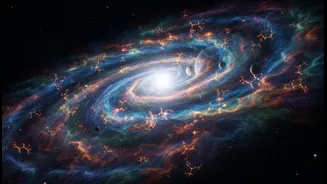
The story of these molecules begins in the coldest, darkest corners of space. In vast, frigid regions called molecular clouds, simple atoms cling to icy dust grains. Over millions of years, energized by faint starlight or cosmic rays, these atoms combine to form more complex structures, including water, methane, and eventually, the precursors to life. These molecule-rich dust grains are the raw material from which new stars and planets are born. As a solar system forms, this organic-rich material gets incorporated into asteroids and comets, which act as frozen time capsules, preserving these precious compounds. These celestial bodies then become interstellar couriers, carrying the ingredients of life across the galaxy.
A Perilous Interstellar Journey
Traveling through interstellar space is no easy feat. Organic molecules must survive a host of dangers, including the vacuum of space, extreme temperature swings, and a constant barrage of destructive ultraviolet (UV) radiation from stars. For a long time, it was a mystery how these relatively fragile compounds could endure such a trip. Scientists now believe they survive by being shielded. Just as a parcel is protected by its packaging, these molecules are often embedded within the icy mantles of dust grains or tucked away deep inside the rocky matrix of asteroids and comets. This protection prevents them from being vaporized or broken apart by radiation, allowing them to remain stable for billions of years as they drift through the void.
How Scientists Play Cosmic Detectives
Unraveling this cosmic story requires some seriously impressive detective work. Astronomers use powerful radio telescopes to detect the faint chemical 'fingerprints' of specific molecules in distant star-forming regions. More recently, the James Webb Space Telescope (JWST) has revolutionized the field. Its incredible sensitivity allows it to peer through dust clouds and analyze the composition of protoplanetary disks and even distant galaxies, revealing an unexpected richness of organic molecules like benzene and methane. Back on Earth, scientists meticulously analyze meteorites, such as a recent one that fell in New Jersey, to study the pristine organic materials they contain. Some studies even recreate space conditions in a lab to test how these molecules form and react.
The Special Delivery to Early Earth
This all leads to a compelling theory about our own origins, sometimes called 'exogenous delivery' or, more evocatively, 'panspermia'. The idea is that during the early, chaotic days of our solar system, Earth was subjected to a constant bombardment by comets and asteroids. This cosmic rain may have delivered a significant portion of both water and the vital organic molecules needed to kickstart life. Rather than Earth having to create all the building blocks from scratch, they may have been delivered, ready-made, from space. This doesn't mean life itself arrived from elsewhere, but that the essential chemical toolkit did, providing the raw ingredients for the planet's first biological experiments.