




What Makes a Cracker 'Green'?
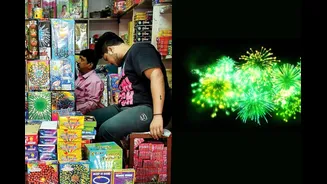
At its core, a 'green cracker' is a firework redesigned to be less polluting than its traditional counterpart. Developed by scientists at India's Council of Scientific and Industrial Research-National Environmental Engineering Research Institute (CSIR-NEERI),
these crackers are not pollution-free, but they are formulated to have a reduced environmental impact. The primary distinction lies in their chemical composition. They are made without harmful chemicals like barium nitrate, a substance common in conventional crackers that contributes significantly to air and noise pollution. To ensure you are buying the real deal, genuine green crackers are required to feature a CSIR-NEERI logo and a QR code on the box, which can be scanned to verify the product's authenticity and manufacturing details.
The Science of a Cleaner Bang
The secret to green crackers lies in altering their chemical recipe to reduce harmful emissions. Scientists have developed several types, most notably SWAS, SAFAL, and STAR. SWAS, or 'Safe Water Releaser', releases water vapour as it burns, which helps suppress dust particles. It avoids potassium nitrate and sulphur, cutting particulate matter emissions by around 30%. SAFAL, or 'Safe Minimal Aluminium', reduces the use of aluminium, a key component in conventional crackers, and uses magnesium instead, resulting in lower noise levels. STAR, the 'Safe Thermite Cracker', also avoids potassium nitrate and sulphur, reducing particulate matter and producing less sound. These formulations are designed to emit at least 30% fewer pollutants like particulate matter, sulphur dioxide, and nitrogen oxides.
How Much Pollution Do They Really Cut?
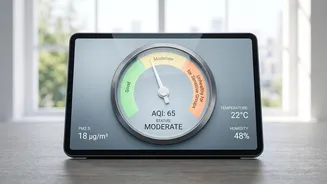
The central claim is that green crackers reduce particulate matter emissions by about 30% compared to traditional fireworks. Some formulations also claim to reduce harmful gases and keep noise levels below the 125-decibel limit. While this is a significant improvement, it is crucial to understand that they are not a zero-pollution solution. They still produce smoke and noise. Environmental experts caution that a 30% reduction is relative to highly polluting traditional crackers, meaning the overall impact on air quality still exists, especially when large numbers are burst. Experience from previous years shows that even with restrictions and the availability of green crackers, air quality can still spike to 'very poor' or 'severe' levels during Diwali, though weather conditions also play a major role.
Navigating the Rules and the Market
Following years of legal battles over festival pollution, the Supreme Court of India has consistently pushed for the regulation of firecrackers, endorsing the use of certified green crackers over conventional ones. These regulations mean that only manufacturers licensed by the Petroleum and Explosives Safety Organisation (PESO) can produce and sell green crackers that conform to CSIR-NEERI formulations. However, challenges remain. The market has seen issues with counterfeit products falsely labelled as 'green'. Furthermore, there are concerns about cost and availability. Some consumers find green crackers to be more expensive than their traditional counterparts, while others report difficulty in finding them or distinguishing them from fakes.