








The Cosmic Data Deluge
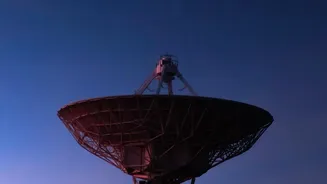
For decades, the Search for Extraterrestrial Intelligence (SETI) has involved scanning the stars for 'technosignatures'—signals that could only be produced by advanced technology. Projects like the SETI Institute's Allen Telescope Array and Breakthrough
Listen use powerful radio telescopes to monitor millions of channels at once. The result is a torrent of data, amounting to petabytes (millions of gigabytes) that must be analyzed. The biggest challenge isn't the volume, but the noise. Our own technology, from mobile phones and Wi-Fi to GPS satellites, creates a constant barrage of radio frequency interference (RFI). Distinguishing a faint, distant signal from a satellite passing overhead or a microwave oven on the ground is an immense and time-consuming task. For years, this interference has been the biggest bottleneck, making it nearly impossible for humans to check every potential signal manually.
Training an AI to Find the 'Whisper'
This is where artificial intelligence, specifically machine learning, has become a game-changer. Instead of relying on old algorithms that struggle in crowded radio spectrums, scientists can now train AI models to do the heavy lifting. Researchers, like a team led by University of Toronto student Peter Ma, developed new algorithms by feeding them simulated alien signals and vast amounts of known human-generated RFI. The AI learns to distinguish the characteristics of a potential technosignature from the noisy, chaotic patterns of Earth-based interference. Using a combination of 'supervised' and 'unsupervised' learning, the AI not only looks for patterns it has been taught to recognize but can also flag anomalies that look entirely new or unexpected—something a human might overlook. This allows it to find the 'whisper in a crowded room' with far greater accuracy than ever before.
Putting AI to the Test
The results have been transformative. In one landmark study, a new AI algorithm was applied to 150 terabytes of data from the Green Bank Telescope that had previously been searched and declared empty of interesting signals. The AI identified eight previously undetected signals of interest coming from the direction of five nearby stars. While follow-up observations did not re-detect them—a crucial step for verification—it proved the method's power. In other projects, collaborations between the SETI Institute, Breakthrough Listen, and tech companies like NVIDIA have developed AI systems that can process data in real time. One system proved to be 600 times faster than previous methods, significantly reducing false positives and enabling astronomers to conduct immediate follow-up observations of intriguing signals. These AI systems have successfully proven their capability by detecting natural cosmic phenomena like pulsars in real-time data streams, demonstrating their readiness for more complex searches.
A Human-AI Partnership for Discovery
AI isn't replacing astronomers; it's augmenting them. The technology acts as an incredibly sophisticated filter, flagging the most promising candidates from billions of signals for human experts to investigate. This partnership is crucial because even the most interesting AI-detected signal is just a candidate, not proof. Every promising signal requires careful follow-up analysis by scientists to rule out all other possibilities. The AI's ability to learn and identify new types of signals, even those we haven't imagined, opens up new avenues for discovery. Dr. Andrew Siemion of the SETI Institute notes that this allows for searches 'free of any preconceived notion of what a technosignature might look like'. This frees up valuable human expertise to focus on the most compelling cosmic mysteries.