




A World of Possibility
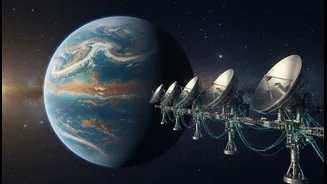
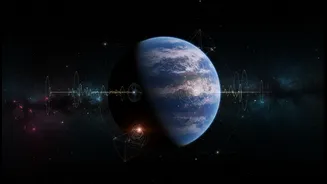
Located 124 light-years away, K2-18b has captivated astronomers since its discovery. It’s a sub-Neptune, larger than Earth but smaller than Neptune, orbiting within its star's habitable zone—the region where liquid water could exist. Observations from
the James Webb Space Telescope (JWST) have made it even more tantalising, revealing carbon-bearing molecules like methane and carbon dioxide in its atmosphere. This led to the compelling hypothesis that K2-18b could be a 'Hycean' world: a planet with a global ocean under a hydrogen-rich atmosphere. Adding to the intrigue, early JWST data hinted at dimethyl sulfide (DMS), a gas that on Earth is overwhelmingly produced by life, specifically marine phytoplankton. This made K2-18b one of the most promising places to look for signs of life.
The Hunt for Cosmic Clues
When scientists search for extraterrestrial life, they look for two main types of evidence: biosignatures and technosignatures. Biosignatures are substances or phenomena that point to life itself, like the potential DMS signal. Technosignatures, on the other hand, are signs of technology. Think of them as cosmic breadcrumbs left by an intelligent civilisation—things like industrial pollutants, city lights, or, most commonly searched for, artificial radio signals. The logic is that any technologically advanced society, whether intentionally or not, might broadcast radio waves that could travel across the stars. So, while one team of scientists debated the faint DMS signal, another group decided to listen for signs of alien engineering.
A Deep and Sensitive Listen
Researchers recently conducted one of the most extensive technosignature searches ever focused on a single target. They used two of the world's most powerful radio telescopes—the Very Large Array in the US and the MeerKAT array in South Africa—to monitor the K2-18 system. The observations spanned a full 33-day orbit of the planet and covered a vast range of radio frequencies with unprecedented sensitivity. After collecting a mountain of data and filtering through millions of potential signals to remove interference from Earth-based technology, the result was clear: they found no radio transmissions that could be attributed to an alien civilisation. No alien radio stations, no planetary radar, no signs of technology talking across the void.
The Power of a 'Null Result'
Finding nothing might sound like a failure, but in science, it's incredibly valuable. This is what the headline refers to as 'better scientific constraints'. The non-detection allows astronomers to place an upper limit on the strength of any potential radio transmitter on K2-18b. Essentially, they can now say, "If there is a civilisation there broadcasting in these frequencies, its transmitters cannot be more powerful than X." In this case, the limit is roughly comparable to the power of some of our own strongest radar facilities on Earth. This constrains the possibilities. It doesn't rule out life, or even technology, but it narrows down what could be there. A null result is not an empty result; it's a new piece of a very large puzzle.
Refining the Search for Tomorrow
Perhaps more important than the result itself is the methodology developed for the search. To sift through millions of signals and distinguish a potential extraterrestrial broadcast from a stray signal from a terrestrial satellite or mobile phone requires incredibly sophisticated software and filtering techniques. The team built a powerful new framework for analysing radio data that can now be applied to future searches of other promising exoplanets. This makes the entire process faster and more effective. Every time scientists conduct a search like this and find nothing, they refine their tools and strategies, making the next search better. This is the slow, methodical, and essential work of exploration.