




Our Solar System’s Rebel
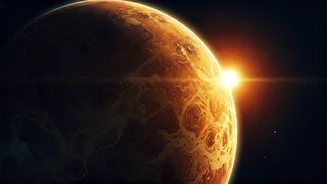
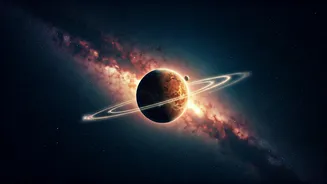
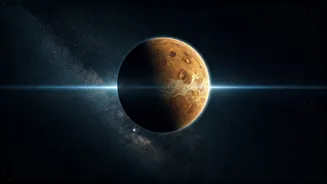
Most planets in our solar system play by a similar set of rules: they rotate on their axis in the same direction they orbit the Sun (counter-clockwise), and their days are much shorter than their years. Then there’s Venus. A year on Venus—the time it takes
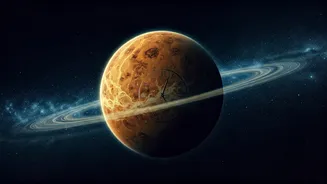
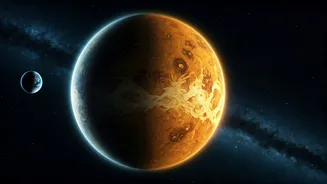
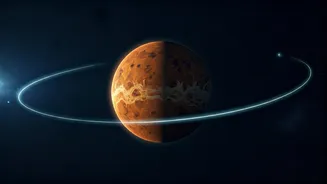
to complete one orbit around the Sun—is about 225 Earth days. But a single day on Venus—one full rotation on its axis—takes a whopping 243 Earth days. This means a Venusian day is longer than a Venusian year. To make things even stranger, it spins 'backwards' or in retrograde motion. If you could stand on Venus's surface, you would see the Sun rise in the west and set in the east. This combination of bizarre traits makes Venus a true outlier and a fascinating puzzle for astronomers.
The Culprit: A Crushing Atmosphere
The primary reason for Venus's slow spin lies in its extreme atmosphere. While we call Venus 'Earth’s twin' due to its similar size and mass, its atmosphere is anything but similar. It is a thick, toxic blanket of carbon dioxide, so dense that the pressure on the planet's surface is over 90 times that of Earth's—equivalent to being nearly a kilometre deep in the ocean. This colossal atmosphere isn't just sitting there; it's a dynamic and powerful force that is physically connected to the solid planet below. The winds in its upper atmosphere move at incredible speeds, circling the planet in just four Earth days, a phenomenon known as 'super-rotation'. This vast, heavy, and fast-moving ocean of air is the main suspect behind the planet's sluggish spin.
How an Atmosphere Brakes a Planet
So, how can an atmosphere slow down a whole planet? The process is a form of tidal friction, but it's not caused by oceans. The Sun's intense heat creates a 'thermal tide' in Venus's thick atmosphere. This causes the atmosphere to bulge out on the side facing the Sun and the side opposite it. Because the atmosphere is so thick and 'heavy', this bulge doesn't move smoothly with the planet's rotation. Instead, it creates drag. Think of it like trying to spin a ball underwater; the resistance of the water slows it down. Over billions of years, this constant atmospheric drag has acted as a powerful brake, slowing Venus's rotation from what was likely a much faster, more 'normal' spin to the crawl we see today. The friction between the solid planet and its thick, sloshing atmosphere has fundamentally reshaped its day.
A Violent Past, A Backward Spin
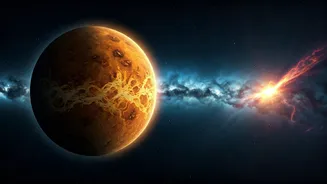
The slow rotation is explained by the atmosphere, but what about its backward, or retrograde, spin? This is likely the result of a completely different and far more violent process from Venus’s distant past. The leading theory is that early in the solar system's history, when protoplanets were still crashing into each other, Venus suffered one or more massive impacts. A collision with a large, planet-sized object could have been powerful enough to not just knock it off its original axis but to completely flip it over or reverse its direction of spin. While the atmospheric braking explains the *speed* of its rotation, a cataclysmic impact event billions of years ago likely explains the *direction*.