
A Perfect Celestial Alignment
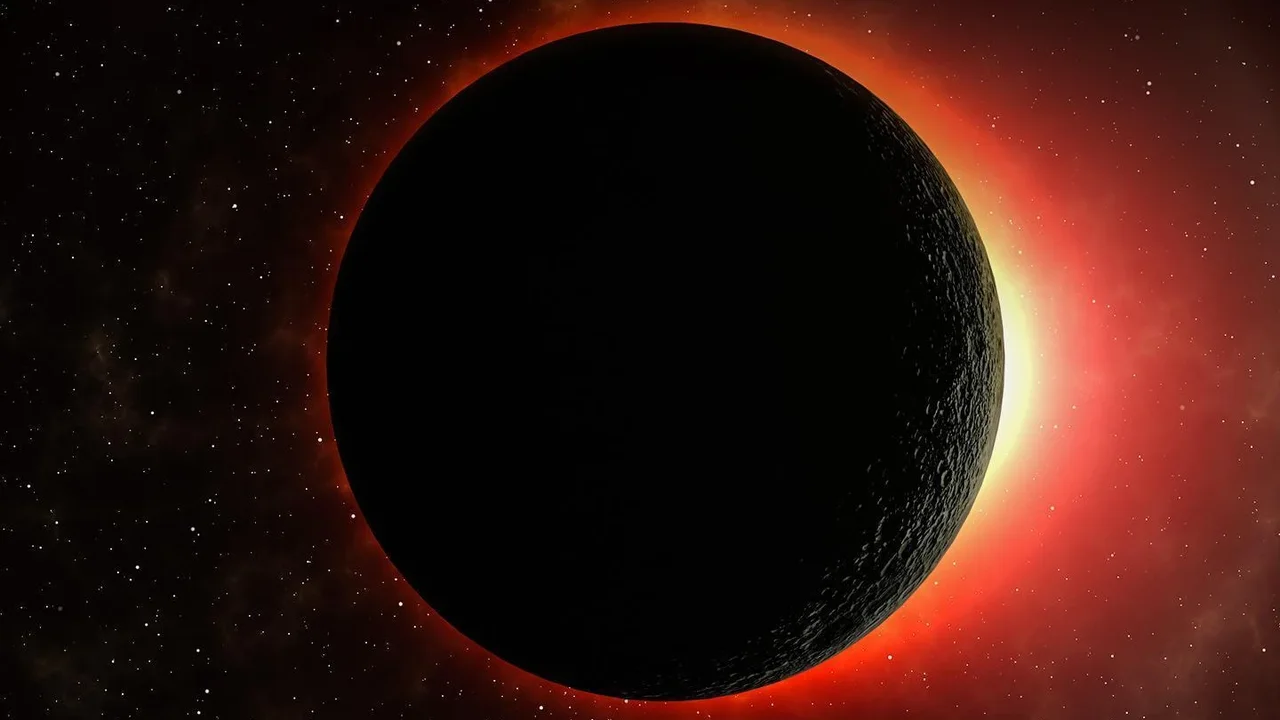
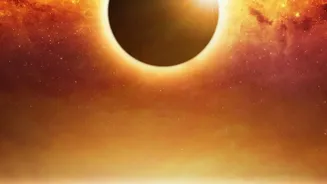
A total solar eclipse occurs when the Moon passes directly between the Sun and Earth, completely blocking the face of the Sun. This cosmic alignment seems like a wild coincidence. The Sun is about 400 times larger than the Moon, but it is also about 400 times farther
away, making them appear almost the exact same size in our sky. This allows the Moon to perfectly obscure the Sun's brilliant disk for a few precious moments. The darkest part of the Moon’s shadow, known as the umbra, traces a narrow path across the Earth’s surface. This is the path of totality. For the August 12, 2026 event, this path stretched over the Arctic, Greenland, Iceland, and northern Spain, offering a spectacular view to observers in those regions.
The Drama of Totality
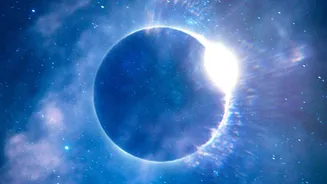
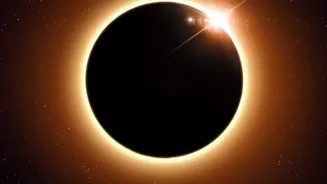
For those within the path of totality, the experience is multisensory and deeply dramatic. As the Moon slides into place, the final slivers of sunlight pour through the rugged valleys on the lunar limb, creating a string of bright spots known as Baily's Beads. When only one bead of light remains, it shines like a brilliant celestial jewel, creating the famous “diamond ring” effect. Then, totality begins. The sky darkens to a deep twilight, the temperature drops noticeably, and bright stars or planets may appear in the daytime sky. For a few minutes—a maximum of about two minutes and 18 seconds for this eclipse—the world is transformed into an otherworldly scene.
Unveiling the Sun’s Ghostly Crown
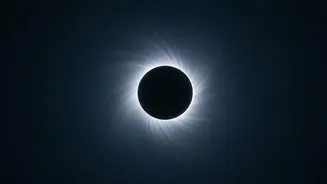
The true star of totality is the solar corona. This is the Sun’s outer atmosphere, a region of incredibly hot, tenuous plasma that streams millions of kilometres into space. Normally, the corona is completely invisible, drowned out by the overwhelming brightness of the Sun's surface, or photosphere. But when the Moon acts as a natural screen during an eclipse, this ethereal, pearly-white crown is revealed in all its glory. The corona is a major scientific puzzle; its temperatures soar to over a million degrees Celsius, far hotter than the 5,500°C surface of the Sun below. Why it is so hot remains one of the biggest unanswered questions in solar physics.
Science in the Shadow
Total solar eclipses are far more than just a pretty sight; they are invaluable opportunities for science. By studying the corona, scientists can better understand the solar wind—a stream of charged particles that constantly flows from the Sun and influences space weather throughout the solar system. Violent eruptions in the corona, called coronal mass ejections, can hurl vast amounts of energy toward Earth, potentially disrupting satellites and power grids. For the August 12 eclipse, NASA-funded teams used a high-altitude research jet and scientific balloons to get a clearer view of the corona's structure and study how the sudden darkness affects Earth's atmosphere, including ozone levels.
A Fleeting Spectacle, Lasting Knowledge
The scientific inquiry during an eclipse isn't limited to professional astronomers. These events often spur massive citizen science projects, where the public can help collect data. Observers might record changes in animal behaviour, as some creatures are tricked into thinking night has fallen, or measure shifts in temperature and light intensity. Even simple observations, when collected from thousands of people, can contribute to a larger scientific understanding. Each eclipse, though fleeting, provides a unique dataset and a chance to test new theories. The 2026 eclipse, for example, was the first to grace Europe since 2015, giving a new generation of scientists and sky-gazers a chance to participate.