

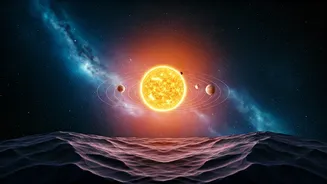


Meet a Cosmic Neighbour
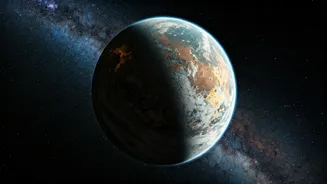
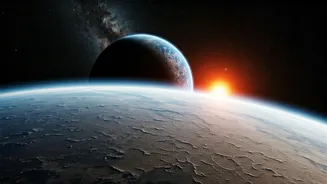
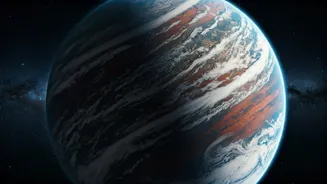
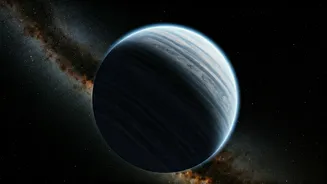
First, let's get acquainted. The planet in question is LHS 1140 b. It's classified as a 'super-Earth,' which means it's larger and more massive than our own planet but smaller than ice giants like Neptune. Specifically, it is about 1.7 times the size
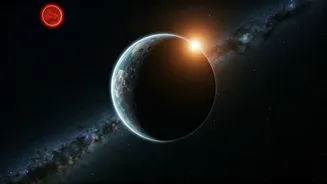
of Earth and boasts a mass more than five times greater. It orbits a red dwarf star, which is smaller and cooler than our Sun, in the constellation Cetus. At a distance of about 49 light-years, it's practically a next-door neighbour in galactic terms, making it a prime candidate for detailed study.
From Gassy Giant to Water World
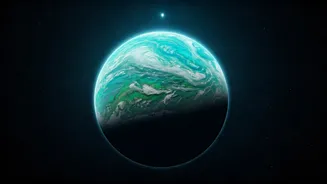
When LHS 1140 b was first discovered in 2017, its properties led to a puzzle. Given its size and mass, one leading theory was that it might be a 'mini-Neptune'—a world with a thick, crushing atmosphere of hydrogen and helium, which would make it inhospitable. However, recent observations using the powerful James Webb Space Telescope (JWST) have turned this idea on its head. By analyzing the light from the host star as it passed through the planet's atmosphere, scientists found no evidence of the prominent hydrogen features expected from a mini-Neptune. This surprising lack of a puffy, gassy envelope points to a much denser world, and the data suggests a compelling alternative: LHS 1140 b could be a water world, with water making up a significant portion of its mass.
What 'Habitable' Really Means
The term 'habitable' can be misleading; it doesn't mean the planet is inhabited, but rather that it could have the right conditions for liquid water to exist on its surface. This region around a star is often called the 'Goldilocks Zone'—not too hot, not too cold. LHS 1140 b orbits squarely within this zone, receiving about 43% of the sunlight Earth does. Its equilibrium temperature is quite cold, around -47 degrees Celsius, but a sufficiently thick atmosphere could create a greenhouse effect, warming the surface enough to support liquid oceans. The new JWST data hints that a nitrogen-rich atmosphere, similar to Earth's, might be present, which would be a monumental discovery if confirmed.
A Potential 'Eyeball' Planet
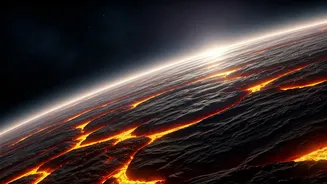
Because it orbits its star so closely, LHS 1140 b is likely 'tidally locked'. This means one side of the planet permanently faces the star while the other is in perpetual darkness, much like how the same side of the Moon always faces Earth. This could create a fascinating scenario. Some models predict the planet could be a 'snowball' world, largely covered in ice. However, the constant daylight on one side could melt the ice, forming a large, circular ocean in the middle of the frozen hemisphere—a configuration charmingly nicknamed an 'eyeball planet'. At the center of this alien ocean, surface temperatures could even reach a comfortable 20 degrees Celsius.
The Journey Ahead
While the new findings are incredibly exciting, scientists are careful to manage expectations. The evidence for a nitrogen atmosphere is still tentative and requires more observation to confirm. Stellar activity from the host red dwarf could also complicate interpretations of the atmospheric data. But the possibility that LHS 1140 b is a water world makes it one of the most compelling targets in the ongoing search for life beyond Earth. Unlike the planets in the famous TRAPPIST-1 system, where some worlds have been found to lack atmospheres, LHS 1140 b's star appears calmer, making it a more stable environment to study. Future observations with the JWST will be crucial in painting a clearer picture of this potential ocean world, bringing us one step closer to answering whether we are alone in the universe.