







The Hundred Billion Dollar Question
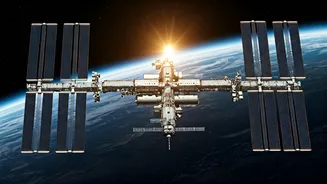
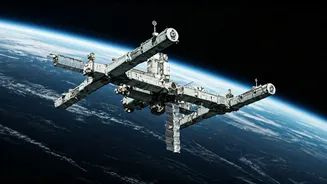
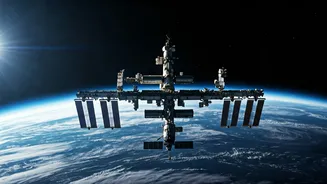
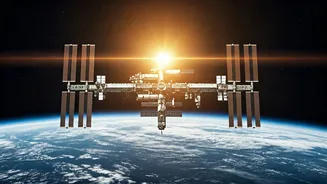
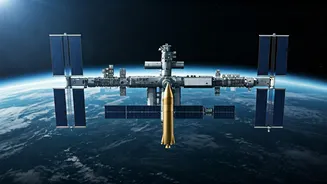
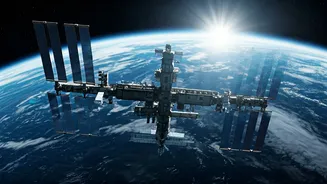
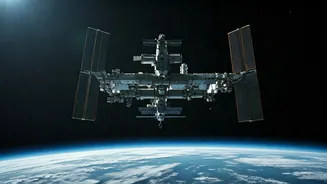
The International Space Station (ISS) is the single most expensive object ever built by humanity. Since its main construction began in 1998, the total cost, including development, assembly, and operations, is estimated to be around $150 billion (or roughly
€100-€150 billion). This colossal expense has been shared by a consortium of 15 nations, including the United States (NASA), Russia (Roscosmos), the European Space Agency (ESA), Japan (JAXA), and Canada (CSA). For decades, this figure was largely a piece of trivia for space enthusiasts. However, in an age of social media and viral comparisons, this number has found a new context, especially in India, where it is being held up against the achievements of the nation's own space program.
India's Frugal Space Superpower
The fascination with the ISS's cost is not born from a critique of international collaboration, but from a surge of national pride in what the Indian Space Research Organisation (ISRO) has achieved with a fraction of such budgets. This is the era of 'frugal innovation', a term that has become synonymous with ISRO. Take the Mars Orbiter Mission (Mangalyaan), which made India the first nation to reach Martian orbit on its first attempt in 2014. Its total cost was approximately $74 million (₹450 crore). This was famously less than the production budget of the Hollywood movie 'Gravity'. More recently, the historic Chandrayaan-3 mission, which made India the first country to soft-land near the lunar south pole, was accomplished for about $75 million (₹615 crore). When young Indians see the ISS's $150 billion price tag, they don't just see an expensive project; they see that India's two most celebrated interplanetary missions cost a combined total that is less than 0.1% of that figure.
A Generation Fueled by Pride and Pragmatism
This striking contrast resonates deeply with a young, digitally-native Indian generation that is both aspirational and deeply pragmatic. On platforms like X (formerly Twitter), Instagram, and Reddit, the cost comparison has become a powerful meme, a shorthand for Indian ingenuity and efficiency. For many, it's a validation of the 'Make in India' spirit and a testament to the country's ability to compete on the world stage, not by outspending, but by out-thinking. This pride is amplified by the fact that ISRO's model proves that major space milestones are achievable without gigantic budgets, a concept that 'democratises' space exploration. It's a narrative of smart power, where clever engineering, a focus on core objectives, and the strategic reuse of technology triumph over brute financial force. This aligns perfectly with the mindset of a generation navigating a competitive global economy, where value-for-money is a celebrated virtue.
More Than Just a Price Tag
Of course, a direct comparison is not entirely fair, and the discussion online often acknowledges this. The ISS is a permanently crewed, modular laboratory in orbit, a project of unprecedented international cooperation designed for long-term research in microgravity. Its running costs alone are about $3 billion annually for NASA. ISRO's missions, by contrast, are primarily unmanned robotic explorers designed for specific scientific objectives and technology demonstrations. The cost of Mangalyaan and Chandrayaan-3 does not include the decades of foundational investment in launch vehicles, ground stations, and human expertise that made them possible. Even so, the conversation isn't really about which approach is 'better'. Instead, it's an appreciation of different philosophies. The ISS represents a model of massive, collaborative, and sustained scientific presence. ISRO represents a model of agile, cost-effective, and milestone-driven exploration that has inspired a nation and challenged global assumptions about what it takes to reach for the stars.