



The Universe's Greatest Enigma
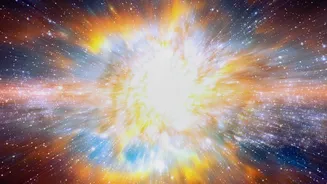
For most of the 20th century, physicists expected the universe’s expansion, which started with the Big Bang, to be slowing down. Gravity, after all, pulls everything together. But in the late 1990s, observations of distant supernovae revealed the opposite
was happening: the expansion is accelerating. This shocking discovery led to the idea of dark energy, a mysterious phenomenon that acts as a sort of cosmic anti-gravity, making up an estimated 68% of the entire universe. We know it exists because we can see its effects, but its fundamental nature remains unknown. Understanding it could determine the ultimate fate of our cosmos—whether it expands forever into a cold, dark void or collapses back on itself in a 'Big Crunch'.
A Telescope Like No Other
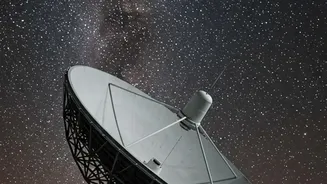
Enter the Canadian Hydrogen Intensity Mapping Experiment, or CHIME. Located in British Columbia, Canada, CHIME doesn't look like a typical telescope. It has no moving parts and consists of four large, 100-metre-long cylindrical reflectors that resemble snowboarding half-pipes. As the Earth rotates, CHIME scans a huge swath of the northern sky every single day. Its primary mission is to create a three-dimensional map of the universe, not by looking at individual stars or galaxies, but by detecting the faint radio waves emitted by the most common element in the cosmos: neutral hydrogen gas.
Listening to Ancient Hydrogen
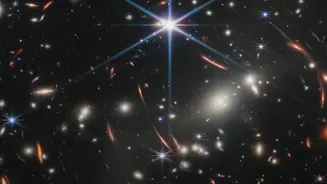
Neutral hydrogen atoms naturally emit radiation at a specific radio wavelength of 21 centimetres. As the universe expands, these ancient radio waves get stretched out, arriving at Earth with a longer wavelength. By measuring the wavelength of the hydrogen signal, CHIME can determine how far away the gas is, and therefore how far back in time it is looking. The telescope is designed to capture these signals from a period when the universe was between 2.5 and 7 billion years old—a crucial era when dark energy began to dominate the cosmic expansion. This technique, called 'intensity mapping', allows scientists to survey enormous volumes of space much faster and more cost-effectively than traditional galaxy surveys, which painstakingly map one galaxy at a time.
The Cosmic Measuring Stick
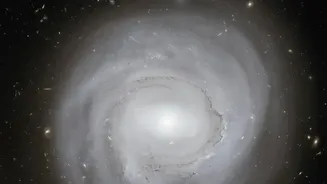
CHIME uses its vast map of hydrogen to measure something called Baryon Acoustic Oscillations (BAOs). Think of BAOs as cosmic fossils. In the very early universe, the cosmos was a hot, dense soup of particles and radiation. Sound waves rippled through this primordial fluid, creating spherical shells of slightly denser matter, much like ripples on a pond. When the universe cooled enough for atoms to form, these ripples became 'frozen' in place. This process left a faint, preferred distance between clusters of matter across the cosmos—a 'standard ruler' whose original size is known to scientists. By measuring the apparent size of this ruler at different points in cosmic history, astronomers can precisely track the expansion rate of the universe and, in turn, the influence of dark energy over time.
A Breakthrough for Cosmology
Recently, the CHIME collaboration announced a major milestone: for the first time, they detected these large-scale hydrogen structures using only CHIME's own data, without needing to cross-reference it with other galaxy surveys. This proves that the intensity mapping technique works as a standalone method, opening a powerful and independent window into the dark energy puzzle. While the result doesn't yet solve the mystery of dark energy, it is a crucial proof of concept. It demonstrates that this novel approach can provide the precise measurements needed to test different theories about what dark energy is and how it behaves. This capability gives scientists a vital new tool to probe one of the most profound questions in modern science.