




A Steamy Atmosphere, Light-Years Away
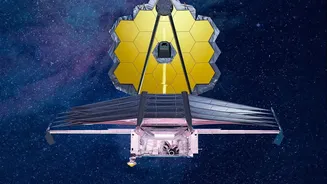
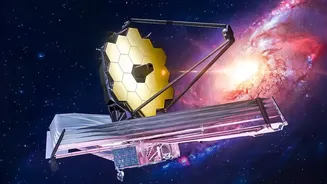
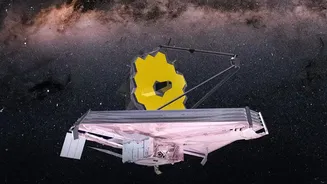
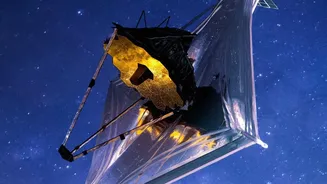
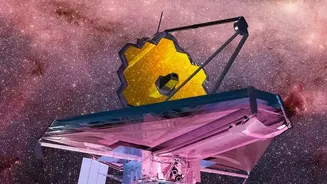
The latest groundbreaking observation from the James Webb Space Telescope has revealed the presence of water vapour in the atmosphere of multiple exoplanets, which are planets that orbit stars outside our solar system. One of the first and most detailed
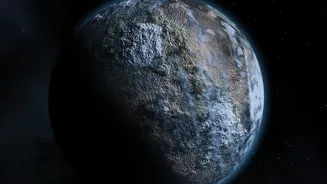
of these observations focused on WASP-96 b, a gas giant located roughly 1,150 light-years away. While this planet is a 'hot, puffy' gas giant and not a candidate for life, the discovery is monumental. The data showed a distinct and unambiguous signature for water. The term 'clear' in this context signifies the strength and clarity of the detection, which was the most detailed of its kind at the time, marking a significant leap forward from the capabilities of previous instruments like the Hubble Space Telescope. For years, astronomers have struggled with observations that were often obscured by thick clouds or hazes in exoplanet atmospheres, but Webb's powerful instruments are changing the game.
How Webb Reads an Alien Sky
Detecting elements from hundreds of light-years away sounds like science fiction, but the JWST does it using a technique called transit spectroscopy. When an exoplanet passes in front of its host star from our perspective, a tiny fraction of the starlight filters through the planet's atmosphere. Different gas molecules in that atmosphere absorb specific colours, or wavelengths, of light. The JWST's highly sensitive instruments, like the Near-Infrared Imager and Slitless Spectrograph (NIRISS), can analyse this filtered starlight and identify the missing colours. These missing pieces create a unique chemical fingerprint, allowing scientists to identify molecules like water, methane, and carbon dioxide. The data gathered is so precise that it can help researchers measure the amount of water vapour, estimate the atmospheric temperature, and infer details about how and where the planet formed.
More Than Just One Watery World
While the initial detailed spectrum from WASP-96 b was a landmark, Webb has continued to find water across a diverse range of exoplanets. It has confirmed water vapour in the atmosphere of WASP-39 b, a 'hot Saturn' about 700 light-years away, as part of a complete profile of its atmosphere that included sodium, potassium, and carbon dioxide. It has also detected water in the air of TOI-421 b, a hot 'sub-Neptune' world, and on the ultra-hot gas giant WASP-18 b, where temperatures are so extreme it's a wonder any water molecules survive at all. Perhaps most excitingly, Webb has detected water vapour in the inner disk of a young star system called PDS 70, which is actively forming planets. This is the first time water has been found in the rocky-planet-forming zone of a system already known to have planets, suggesting that the building blocks for habitable worlds could be common.
A Crucial Ingredient, But Not a Guarantee of Life
Finding water vapour is a monumental step, as water is an essential ingredient for life as we know it. On Earth, it plays a key role in regulating climate through the greenhouse effect and enabling biological processes. However, the presence of water vapour alone does not mean a planet is habitable. Many of the planets where Webb has found water, like WASP-96 b and WASP-18 b, are gas giants with scorching temperatures, far too hostile for life. Others, like the rocky planet GJ 486 b, which may have a water-rich atmosphere, orbit so close to their star that surface temperatures reach hundreds of degrees. The discovery of water is a crucial piece of the puzzle, but habitability requires many other factors, including the right temperature for liquid water to exist on the surface and a stable environment.