





A New Dawn for Solar Power
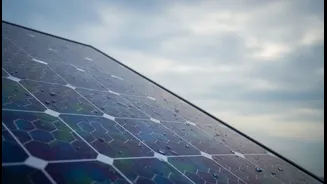
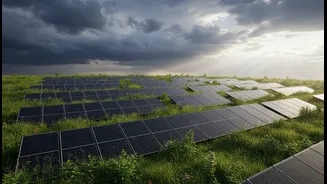
India has bet big on solar energy, with ambitious national goals to power its future with clean electricity. The country is blessed with an abundance of sunshine for most of the year. However, the annual monsoon season and generally overcast days present
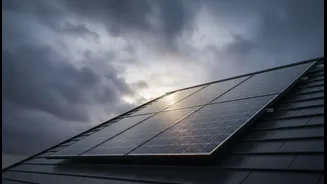
a significant challenge, often causing solar panel output to drop dramatically. Traditional silicon-based solar panels perform best under direct, bright sunlight, with their efficiency falling to just 10-25% of their rated capacity on heavily overcast days. This variability is a major hurdle for a consistent and reliable power grid. Now, researchers are pioneering a solution: flexible solar films that excel where traditional panels struggle.
The Science of 'Indoor' Solar
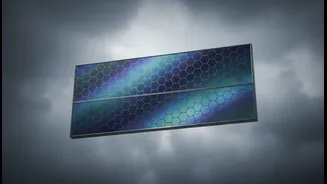
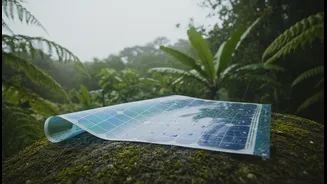
The new technology largely revolves around two types of materials: perovskites and organic photovoltaics (OPV). Unlike the rigid, bulky silicon wafers used in conventional panels, these materials can be formulated into ultra-thin, flexible, and even transparent films. Perovskites are a class of materials with a specific crystal structure that is exceptionally good at absorbing light. Scientists can 'tune' the material to be highly sensitive to the diffused, scattered light common on cloudy days or even the artificial light found indoors. Similarly, organic photovoltaics use carbon-based molecules to capture light, a technology more akin to OLEDs used in high-end television screens. These materials are less sensitive to the angle or intensity of light, making them ideal for less-than-perfect weather.
The Monsoon-Proof Advantage
The key advantage is their performance in low-light conditions. While a conventional solar panel's output plummets under a grey sky, some of these new films have demonstrated remarkable efficiency. Recent lab tests have shown certain perovskite cells achieving over 38% efficiency under low indoor lighting levels, far surpassing traditional technologies in the same environment. Organic photovoltaic cells have also demonstrated efficiencies above 28% in ambient light. This means they can continue to generate a meaningful amount of electricity during dense cloud cover, haze, or the peak of the monsoon season. This breakthrough could help stabilize India's renewable energy supply, making solar a more dependable year-round power source.
Beyond Rooftops: Powering India's Cities
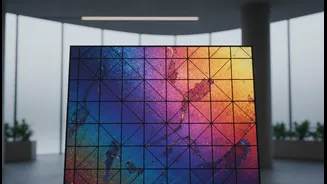
Because these new solar materials are lightweight, flexible, and can be made semi-transparent, they open up a world of possibilities beyond rigid rooftop panels. Imagine windows on a skyscraper generating electricity, or building facades coated in a power-producing film. They could be integrated into vehicle roofs, backpacks, or temporary structures in remote villages, providing decentralized power where the grid doesn't reach. For India's dense, rapidly growing cities, the ability to turn almost any surface into a solar generator is a game-changer. This could significantly reduce the pressure on land for large-scale solar farms and bring power generation closer to where it's consumed.
From Lab to Lightbulb: The Road Ahead
While the potential is enormous, this technology is still in the advanced stages of development. The primary challenges for both perovskite and organic cells are long-term durability and manufacturing scale. Perovskite materials, in particular, can be sensitive to moisture and oxygen, though recent research has made significant strides in improving their stability. Researchers are working to ensure these films can withstand years of harsh weather and temperature fluctuations. The transition from small, highly efficient lab cells to large, affordable, and durable commercial panels is a complex engineering challenge. However, with global investment pouring into this field, many experts believe these films could start complementing traditional solar panels within the next decade, fundamentally changing how and where we harvest solar energy.