


The Quest for Reusability
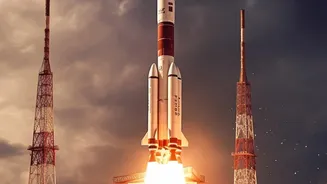
For decades, space launches operated on a simple but costly principle: build a powerful rocket, use it once, and let it fall into the ocean. This made space exploration an incredibly expensive endeavor, as the most sophisticated and costly components
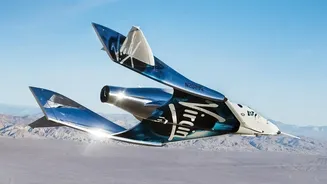
were discarded after a single flight. A Reusable Launch Vehicle (RLV) fundamentally changes this model. Much like a commercial airplane, an RLV is designed to return to Earth intact after its mission, allowing its most expensive parts—the engines, avionics, and structures—to be refurbished and flown again. This shift from a disposable to a transportation model is the single most important factor in reducing launch costs. Some estimates suggest that mastering this technology could cut the expense of putting a payload into orbit by as much as 80-90%.
Pushpak: India’s Winged Space Plane
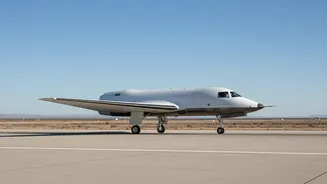
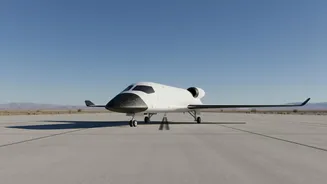
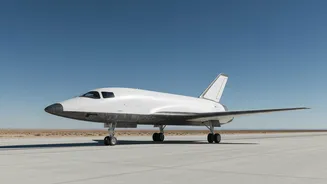
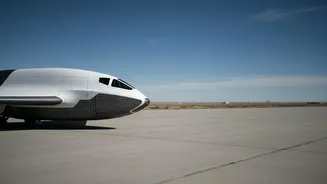
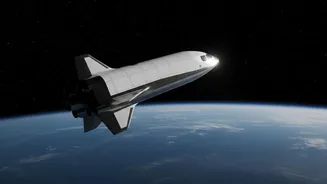
ISRO’s answer to the reusability challenge is a winged vehicle named 'Pushpak'. Unlike the vertical-landing boosters popularized by companies like SpaceX, ISRO's RLV-Technology Demonstrator (RLV-TD) is designed to land horizontally on a runway, much like a conventional aircraft or the American space shuttle. This winged body configuration is part of a long-term vision for a Two-Stage-to-Orbit (TSTO) launch system, where the reusable first stage would fly back to a landing strip after separating from the upper stage carrying the satellite. The Pushpak vehicle is a scaled-down demonstrator acting as a flying testbed for the critical technologies needed for autonomous navigation, hypersonic flight, and, most importantly, a controlled, high-speed runway landing.
A Hat-Trick of Landing Successes
ISRO has achieved a series of critical milestones with its Landing Experiments (LEX). In these tests, the Pushpak vehicle was lifted to an altitude of 4.5 kilometers by an Indian Air Force Chinook helicopter and released mid-air to simulate the final phase of a return from space. From there, the vehicle had to autonomously navigate its way to the runway, correct its trajectory against winds and other disturbances, and perform a precise, high-speed landing. The final test in the series, LEX-03, was conducted under the most challenging conditions yet, with the vehicle released at a greater lateral distance from the runway and in more severe winds. Pushpak successfully executed its maneuvers and touched down at over 320 km/h before using a brake parachute and its landing gear brakes to come to a stop. Crucially, the same winged body from the LEX-02 mission was reused for LEX-03, demonstrating the hardware's robustness and reusability.
The Economic Revolution in Orbit
The primary driver behind the RLV program is economics. About 80% of a rocket's cost is in its structure and engines, with only 20% being fuel. By recovering and reusing the vehicle, ISRO aims to dramatically lower its launch costs, which could potentially drop to as little as one-tenth of current expenses. This would not only make India's own national space missions more affordable but also significantly boost its competitiveness in the multi-billion dollar global satellite launch market. Cheaper access to space accelerates the deployment of satellite constellations for communication, Earth observation, and navigation, fueling downstream economies and strategic capabilities. With private Indian companies also entering the race to build reusable rockets, the nation's space ecosystem is on the verge of a major transformation.
What Lies Ahead for ISRO’s RLV?
Having successfully completed the landing experiment series, ISRO is now setting its sights on the next major challenge: the Orbital Re-entry Experiment (OREX). This phase will involve launching a vehicle into orbit and having it perform a controlled re-entry through Earth's atmosphere, enduring extreme temperatures before making an autonomous runway landing. This will test the vehicle's thermal protection systems and its ability to handle the full mission profile. Beyond the Pushpak demonstrator, ISRO is also developing a Next Generation Launch Vehicle (NGLV), a heavy-lift rocket with a partially reusable first stage. While a fully operational Indian reusable launch system is still several years away, the recent string of successes with Pushpak proves that the core technologies are being mastered, paving the way for India's cost-effective future in space.