






The Blueprint of Balance
Tadasana is often called the blueprint for all standing poses for good reason. It teaches the body how to stand with intention, aligning your skeleton and engaging muscles to create stability from the ground up. Before focusing on breath, establish your physical
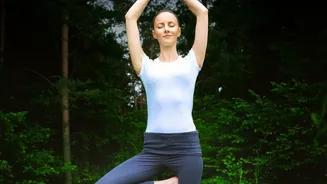
foundation. Stand with your feet either together or hip-width apart, ensuring they are parallel. Distribute your weight evenly across all four corners of each foot. Engage your thigh muscles without locking your knees, and maintain a neutral pelvis. Lengthen your spine, roll your shoulders back and down, and allow your arms to rest by your sides with palms facing forward. This alignment creates a stable structure, a prerequisite for refined balance.
Why Your Breath Is Your Anchor
In yoga, the breath, or 'prana', is the vital life force that connects the body and mind. When you're trying to balance, your nervous system can become agitated, leading to shallow chest breathing. This type of breathing is often associated with stress and can create more instability. The key is to shift to diaphragmatic breathing, also known as 'belly breathing'. This technique has a profound calming effect on the nervous system. By consciously controlling your breath, you are sending a signal to your brain that you are safe and in control, which in turn quiets the mental chatter that can throw you off balance.
The Mechanics of a Balancing Breath
Diaphragmatic breathing involves engaging the diaphragm, a large, dome-shaped muscle at the base of your lungs. To practice this in Mountain Pose, place one hand on your chest and the other on your belly. As you inhale slowly through your nose, focus on sending the breath down so that your belly expands and the hand on your abdomen rises. The hand on your chest should remain relatively still. As you exhale slowly, feel your belly gently contract. This deep, slow breathing ensures your lungs fill completely, maximizing oxygen intake and promoting a state of calm focus essential for stability.
Syncing Breath with Sensation
Once you have the mechanics down, begin to sync the breath with the physical sensations of the pose. On your inhalation, feel a sense of lift and expansion. Imagine energy drawing up from the soles of your feet, lengthening your spine all the way through the crown of your head. As your belly expands, feel the grounding force through your feet increase. On your exhalation, maintain that length but feel a sense of rooting and release. Let go of any unnecessary tension in your shoulders, jaw, and face. This rhythmic cycle of expanding and grounding with each breath creates a dynamic stability, allowing you to make micro-adjustments to maintain your balance with ease.
Common Mistakes to Avoid
One of the most common mistakes in any balancing pose is holding your breath. The moment you feel yourself wobble, the tendency is to freeze and stop breathing, which only increases tension and instability. Instead, make your exhale longer than your inhale, which helps to further calm the nervous system. Another error is shallow breathing that only moves the chest. This fails to engage the calming power of the diaphragm. Also, avoid letting your ribs flare out as you inhale deeply; keep your core gently engaged to maintain spinal alignment.