






Your Feet: The Forgotten Foundation
We spend our lives in shoes, often with thick, cushioned soles that disconnect us from the ground. While protective, this can lead to weak, 'lazy' feet. Your feet contain a complex network of 26 bones, 33 joints, and over 100 muscles, ligaments, and tendons.
They are designed to adapt, grip, and send constant feedback to your brain about your position in space—a process called proprioception. When these muscles are underused, the arch can weaken, and the ankle becomes less stable. This instability doesn't stay in the foot. It creates a chain reaction up the body, potentially affecting knee alignment, hip position, and even causing the slouched shoulders and forward head posture many of us struggle with. Reconnecting with the ground barefoot helps re-awaken this system.
Why a Park is Your New Gym
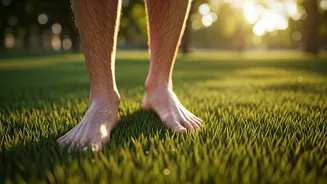
A park, with its varied, natural surfaces like grass, dirt, and gentle slopes, is the perfect environment for this kind of work. Unlike a flat, hard gym floor, uneven ground challenges the small stabilising muscles in your feet and ankles to fire constantly. Each step becomes a mini-workout for balance and control. The natural textures stimulate the thousands of nerve endings on the soles of your feet, enhancing proprioceptive feedback and helping your brain build a better map of your body. Before you start, find a clean, safe area free from sharp objects. A few minutes is all you need to begin.
Drill 1: The Short Foot
This is the cornerstone of foot-strengthening exercises. It activates the intrinsic muscles that support your arch. **How to do it:** Stand with your feet hip-width apart. Without curling your toes, try to draw the ball of your foot back towards your heel, as if you're trying to shorten your foot. You should feel the arch of your foot lift and engage. Your toes should remain flat and relaxed. Hold for 5-10 seconds, then release. Aim for 10 repetitions on each foot. **Why it works:** This directly targets the muscles that prevent the arch from collapsing (pronation), which is a common contributor to poor ankle, knee, and hip mechanics.
Drill 2: Toe Yoga
Our toes are often crammed together in shoes, losing their ability to spread and grip. These drills restore their dexterity and strength. **How to do it:** While standing, try to lift just your big toe while keeping the other four toes pressed firmly into the ground. Hold for a few seconds, then lower it. Next, reverse it: keep your big toe down and lift the other four toes. It’s harder than it sounds! Finally, try to splay your toes as wide as you can, like you're making a 'foot fan'. **Why it works:** Independent toe control is crucial for balance. Strong, dextrous toes help distribute weight evenly across the foot during walking and standing, providing a wider and more stable base of support.
Drill 3: Mindful Heel-to-Toe Walking
Slow down your walk to retrain your natural gait pattern. This is about quality, not speed. **How to do it:** Walk forward slowly in a straight line. Focus on landing gently on your heel. Roll smoothly through the midfoot, feeling the ground beneath you. Then, consciously push off from your big toe to propel yourself into the next step. Try this for 20-30 metres, then turn around and repeat. Pay attention to how your ankle and foot move through the entire motion. **Why it works:** Modern life encourages a shuffling gait. This drill re-establishes the proper mechanics of walking, improving shock absorption and ensuring your foot and ankle are used as the dynamic levers they are meant to be.
Drill 4: Single-Leg Balance
This classic exercise becomes infinitely more effective when done barefoot on an uneven surface like grass. **How to do it:** Stand on one leg and try to hold your balance for 30 seconds. Your foot and ankle will be making constant, tiny adjustments. Keep your gaze fixed on a stationary point in the distance to help. Once you’re stable, try closing your eyes for a few seconds to really challenge your proprioception. Switch legs and repeat. **Why it works:** By removing visual cues (especially with eyes closed) and adding the instability of the ground, this drill forces your ankle stabilisers to work overtime, building strength and reactive control that translates directly to better balance in everyday life.