



A Junkyard in the Sky
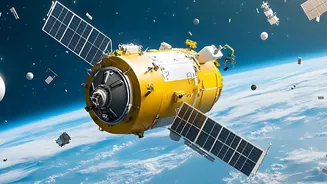
The area around our planet is littered with 'space debris'. This junk includes everything from defunct satellites and old rocket stages to tools dropped by astronauts and even flecks of paint. Since 1957, humanity has launched thousands of objects into
orbit. While many have burned up re-entering the atmosphere, a huge amount remains. As of 2026, the U.S. Space Surveillance Network tracks over 32,000 objects larger than 10 centimetres. Of these, only a fraction are active satellites; the rest is junk. The real problem is what can't be tracked: there are an estimated 1.2 million objects between one and 10 centimetres, and over 140 million fragments smaller than that. Each one is a potential cannonball for an orbiting habitat like the International Space Station (ISS).
The Danger of Orbital Speed
The primary danger isn't the size of the debris, but its incredible speed. Objects in low-Earth orbit travel at around 28,000 kilometres per hour, roughly ten times faster than a bullet. At this velocity, the kinetic energy is immense. A collision with a tiny, centimetre-sized object can be equivalent to the impact of a hand grenade, capable of disabling a critical spacecraft system or puncturing a module. Even a fleck of paint can cause significant damage, such as chipping the windows of a space station, as has been seen on the ISS. This is why space agencies are concerned about every screw, bolt, and fragment left behind—in space, there is no such thing as a harmless piece of trash.
The Global Tracking Network
To protect valuable assets like space stations and the astronauts inside, a global network of sensors keeps a constant watch. The primary system is the U.S. Space Surveillance Network (SSN), operated by the U.S. Space Force. It uses a worldwide collection of powerful ground-based radars and optical telescopes to detect, track, and catalogue objects orbiting Earth. Radars are the main tool for tracking objects in low-Earth orbit, while optical telescopes are better for objects in higher orbits, which they spot by seeing the sunlight they reflect. This network generates tens of thousands of observations daily, which are used to maintain a catalogue and predict the future paths of objects to identify potential collisions.
Dodging Bullets in Orbit
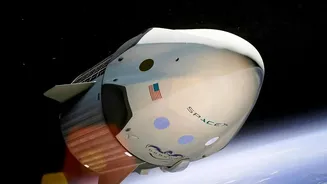
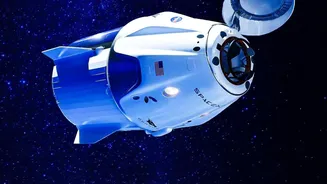
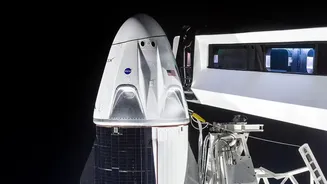
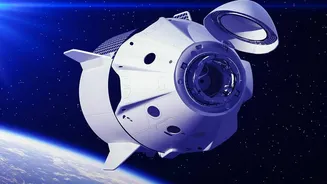
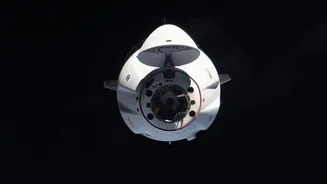
When the network predicts that a piece of debris will pass dangerously close to a space station, mission controllers have to act. This process is known as a collision avoidance maneuver. For the ISS, this involves firing the thrusters of either the station itself or a docked spacecraft to slightly alter its altitude and speed, moving it out of the debris's path. These maneuvers are becoming increasingly common. While there may only be a few per year for the station, they are a routine part of space operations. Sometimes, debris is detected too late to perform a maneuver, forcing the crew to take shelter in their return spacecraft as a precaution until the danger has passed.
A Worsening Traffic Jam
The orbital debris problem is getting worse. The rise of satellite 'mega-constellations' from companies like SpaceX's Starlink and Amazon's Project Kuiper means that tens of thousands of new satellites are being added to already congested orbits. More satellites mean a higher risk of collisions. This raises concerns about a theoretical chain reaction called the Kessler Syndrome, proposed by NASA scientist Donald Kessler in 1978. In this scenario, a collision creates a cloud of debris, which increases the likelihood of more collisions, creating even more debris. Eventually, this cascade could render certain orbits unusable for generations, trapping us on Earth and crippling the satellite infrastructure we rely on for communication, navigation, and weather forecasting.