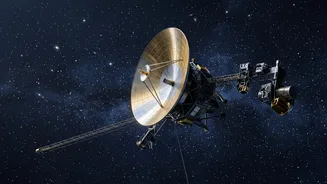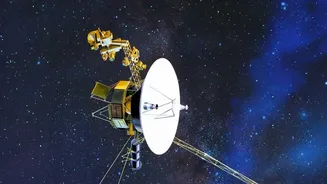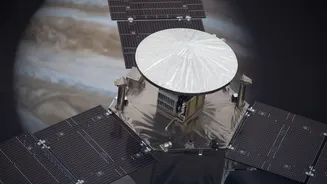




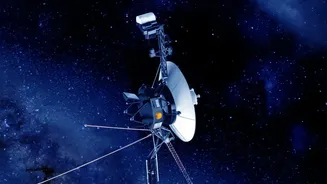
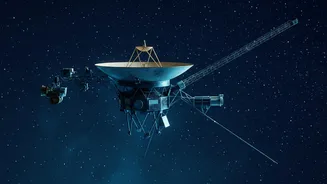
After nearly 49 years pushing the boundaries of space, humanity’s farthest envoy, Voyager 1, gave its mission team a scare. Following a tense two-day communication blackout, a signal has been reacquired, confirming the resilient probe is alive.
A Signal from the Void
For two
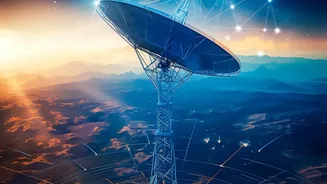
nail-biting days in mid-October, NASA’s Deep Space Network, a global array of giant antennas, listened for Voyager 1 and heard only silence. Scheduled communication attempts on October 18 and 19 yielded nothing from the spacecraft, which is now more than 25 billion kilometers from Earth. Then, on October 20, before engineers could even send troubleshooting commands, Voyager 1 phoned home on its own. The signal was back, and a collective sigh of relief was felt at NASA's Jet Propulsion Laboratory (JPL). The incident was a stark reminder of the immense challenges of operating a vintage spacecraft so far from home.
Diagnosing a Distant Patient
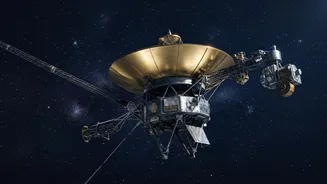
Troubleshooting a problem on Voyager 1 is unlike any repair job on Earth. With the probe currently speeding toward a new milestone—a distance of one light-day from Earth—a radio signal traveling at the speed of light takes nearly 24 hours to reach it. That means a simple 'hello' and its reply requires a two-day wait. Engineers are still investigating the cause of the blackout, but early analysis suggests the spacecraft's fault protection system automatically activated. It appears one set of thrusters, which are used to keep the probe's antenna pointed at Earth, went offline, and a backup set automatically switched on. This safety protocol likely put the spacecraft into a stable but quiet state, giving engineers time to assess the situation.
The Grand Tour's Enduring Legacy
Launched in 1977, Voyager 1’s original five-year mission was to conduct a 'Grand Tour' of Jupiter and Saturn. It gave humanity its first close-up views of Jupiter’s swirling Great Red Spot and discovered active volcanoes on its moon, Io. At Saturn, it provided stunning details of the planet's intricate ring system. After its planetary encounters, the mission was extended. In 1990, it turned its camera back one last time to capture the iconic 'Pale Blue Dot' image of Earth. In August 2012, Voyager 1 made history by crossing the heliopause, the boundary where the Sun's influence gives way to the interstellar medium, becoming the first human-made object to enter interstellar space.
Why Voyager Still Matters
Even with many of its original instruments powered down to save energy, Voyager 1 continues to perform invaluable science. It is our only direct source of data from interstellar space, measuring the cosmic rays, magnetic fields, and plasma density of the medium between stars. This information is crucial for understanding the environment our solar system moves through. The recent communication scare occurred shortly after engineers performed a clever power-shuffling maneuver nicknamed the 'Big Bang', which swapped out some older components for lower-power alternatives to extend the life of the remaining science instruments. Without these efforts, another instrument would have likely been turned off by 2027.
A Race Against Time
The long term challenge for Voyager 1 is its dwindling power supply. The spacecraft is powered by a radioisotope thermoelectric generator, which converts heat from decaying plutonium into electricity. With its nuclear fuel decaying, the probe loses about four watts of power each year. This forces engineers at JPL to make difficult decisions about which systems to keep running. Eventually, likely by the mid -2030s, there won't be enough power to operate any science instruments or transmit a signal back to Earth. Until then, each day of data is a bonus, a message from humanity's silent ambassador to the galaxy.