


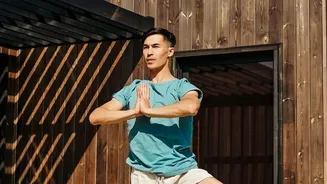
The Foundation: Finding Stability in Tree Pose
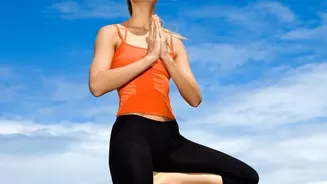
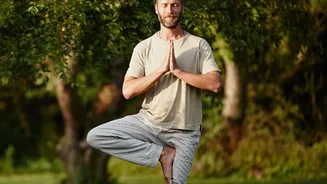
Before you can fly, you need strong roots. In yoga, Tree Pose, or Vrksasana, is the ultimate practice for building a stable foundation. This classic standing balance teaches you how to ground down through one leg while engaging your entire body to stay
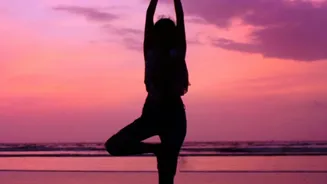
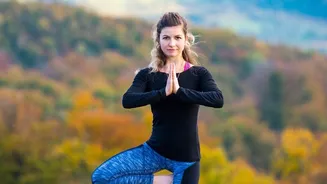
upright. To practice Tree Pose, begin by shifting your weight onto one foot, pressing it firmly into the mat. The muscles of your standing leg—quadriceps, glutes, and the small stabilizers around your ankle—all fire up to keep you steady. The other foot rests on your inner ankle, calf, or thigh, but never directly on the knee joint. This external rotation of the lifted leg's hip opens the pelvis, while your core engages to prevent your torso from swaying. Finding a non-moving focal point, or drishti, helps quiet the mind and improve concentration, a skill essential for all balancing postures.
From Root to Flight: Why Tree Prepares You for Warrior
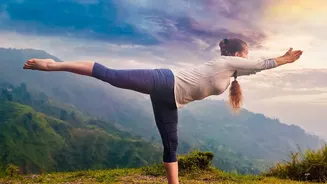
At first glance, the vertical alignment of Tree Pose and the horizontal line of Warrior III (Virabhadrasana III) seem worlds apart. However, the skills you cultivate in Tree Pose are precisely what you need for a successful Warrior III. Both poses demand immense single-leg strength and stability. The muscles you strengthen in your standing leg in Vrksasana are the same ones that will hold you steady as you tilt your torso forward into Virabhadrasana III. Furthermore, Tree Pose teaches subtle core engagement and hip stabilization that are non-negotiable in Warrior III, where a common challenge is preventing the hip of the lifted leg from rolling open. Mastering the art of staying calm and focused through the wobbles in Tree Pose builds the mental resilience needed to hold the powerful, energetic line of Warrior III.
The Transition: Hinging from the Hips
The bridge between Tree and Warrior III is the hip hinge. While Tree Pose is about verticality, Warrior III is about extending horizontally from the hip joint, creating a 'T' shape with the body. To explore this movement, start in a stable Tree Pose with your hands at your heart. Keeping your spine long, begin to float your lifted knee forward, then extend it straight back as you simultaneously hinge your torso forward from the hips. The key is to move as one cohesive unit, maintaining a straight line from the crown of your head to the heel of your lifted leg. Your core must remain deeply engaged to support your lower back and keep your pelvis level. Think of pressing your back heel into an imaginary wall behind you to activate the entire leg and create oppositional energy.
Your Guide to Warrior III
Ready to take flight? From a standing position, shift your weight to one foot. Inhale to lengthen your spine. As you exhale, hinge forward from your hips, extending your opposite leg straight behind you. Continue hinging until your torso and lifted leg are parallel to the floor, or as close as you can get while maintaining control. Keep the toes of your lifted foot pointing down toward the mat to ensure your hips remain square. There are several arm variations: extend them forward like Superman to build shoulder and back strength, take them out to the sides like airplane wings for more stability, or keep your hands at your heart for focus. Remember to keep a micro-bend in your standing knee to avoid locking the joint. Breathe steadily and hold your gaze on a fixed point on the floor just ahead of you.
Variations and Support for Your Practice
Warrior III is a challenging pose, and it's normal to feel unsteady. Using props can make it much more accessible. Place yoga blocks on the floor under your hands for support as you learn the alignment; this allows you to build strength without the full balance challenge. You can also practice facing a wall, placing your hands on it for stability as you extend your leg back. If you struggle with keeping your hips level, focus on rotating the inner thigh of your lifted leg up toward the ceiling. Don't be discouraged by wobbles—they are a sign that your muscles are learning and getting stronger. The goal isn't perfection, but patient exploration of your strength and balance.