

The Ghost in the Machine
To understand the universe, you first need to know what it’s made of. Scientists believe everything we can see—stars, planets, and galaxies—makes up only about 5% of the cosmos. The rest is a mystery. About 27% is thought to be 'dark matter', an invisible
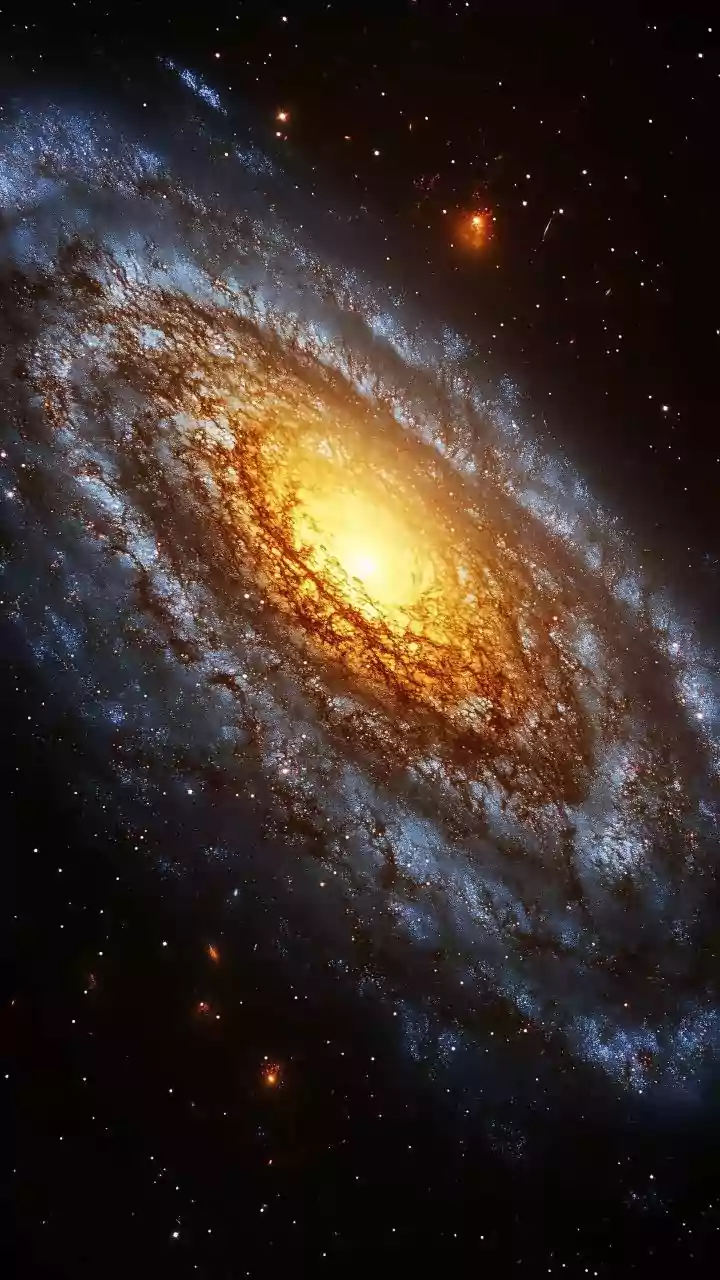
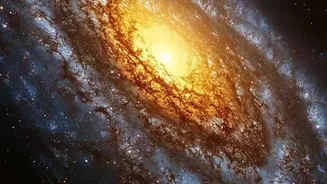
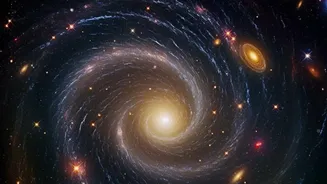
substance that doesn’t interact with light but exerts a powerful gravitational pull. The remaining 68% is 'dark energy', a force driving the universe's expansion. The idea of dark matter isn't new; it was first proposed nearly a century ago when astronomers noticed galaxies were spinning so fast they should have flown apart. The only explanation was that some unseen 'dark' matter was providing the extra gravity needed to hold them together. This concept became a cornerstone of the standard model of cosmology, known as Lambda-CDM.
Cracks in the Standard Model
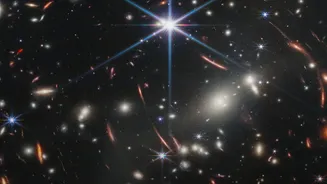
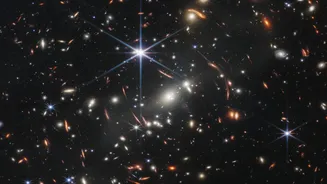
The Lambda-CDM model has been incredibly successful, explaining the large-scale structure of the universe and the cosmic microwave background radiation—the afterglow of the Big Bang. Yet, it has a glaring problem: despite decades of searching with highly sensitive experiments, no one has ever directly detected a dark matter particle. This has led some scientists to question whether dark matter is real. Recent observations from the James Webb Space Telescope (JWST) have added to the puzzle, revealing ancient galaxies from the early universe that appear more mature and well-formed than Lambda-CDM predicts. These findings have created an opening for alternative theories to gain traction.
An Alternative Theory of Gravity
One of the leading alternatives to dark matter is a theory called Modified Newtonian Dynamics, or MOND. First proposed in the 1980s by physicist Mordehai Milgrom, MOND suggests that we don’t need an invisible substance to explain the universe's extra gravity. Instead, the theory proposes that gravity itself behaves differently at very low accelerations, such as those found in the outer edges of galaxies. In simple terms, MOND argues that our understanding of gravity, based on the laws of Newton and Einstein, is incomplete. By slightly tweaking the rules of gravity, MOND can explain the rapid rotation of galaxies without any need for dark matter. Proponents argue it provides a more elegant solution than inventing a mysterious, undetectable substance.
A Test in the Ancient Cosmos
The headline's 'older universe' refers to studying the early universe. By observing galaxies billions of light-years away, telescopes like the JWST are essentially looking back in time. This provides a perfect laboratory to test whether MOND or the dark matter model best fits the data. Several recent studies, some led by astronomer Kyu-Hyun Chae of Sejong University, have analysed the movements of stars and galaxies, finding evidence that appears to favour MOND. One study of wide binary star systems found their movements deviated from standard gravity in a way that aligned with MOND's predictions. Another recent model called CCC+TL (Covarying Coupling Constants plus Tired Light), proposed by Rajendra Gupta at the University of Ottawa, also claims to explain galactic rotation and the mature appearance of early galaxies without dark matter, suggesting the universe could be much older than the standard 13.8 billion years.
Is This the End for Dark Matter?
Not so fast. While these new findings are compelling, they don't represent a final verdict. The Lambda-CDM model with dark matter remains the dominant theory because it successfully explains a wider range of cosmic phenomena, especially the large-scale structure of the universe and the patterns in the cosmic microwave background. MOND, while excellent at explaining galaxy rotation, has struggled to account for observations on larger scales, like the behaviour of galaxy clusters. Furthermore, some experiments continue to report tantalising, though unconfirmed, potential detections of dark matter particles. The scientific community remains divided, and the debate is far from settled. This is not a failure of science but rather science in action. Theories are being tested, evidence is being gathered, and our understanding is evolving.