







The Challenge of Coming Home
Any object entering a planet's atmosphere at hypersonic speeds compresses the air in front of it, creating immense heat and pressure. Without protection, a spacecraft would be incinerated. The traditional solution has been rigid heat shields, made from
materials that either burn away (ablative shields like those on the Apollo capsules) or absorb and radiate the heat (like the Space Shuttle's ceramic tiles). These have worked, but they have a major limitation: their size is restricted by the diameter of the rocket fairing they launch in. This size constraint limits how much mass can be slowed down, which in turn limits the size of payloads we can land on other worlds or return to Earth.
An Unlikely Solution: Just Add Air
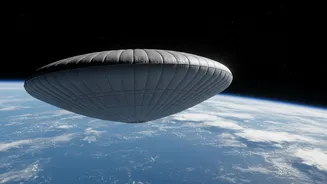
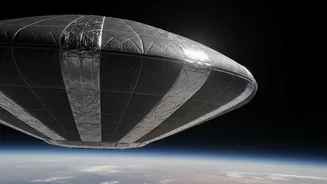
Enter the Hypersonic Inflatable Aerodynamic Decelerator, or HIAD. The concept is as surprising as it is effective. Instead of a solid shield, a HIAD is a structure that is packed tightly for launch and then inflated like a giant, ultra-resilient mushroom just before atmospheric entry. This technology, developed by NASA over the last two decades, combines the functions of a heat shield and a decelerator. By creating a much larger surface area than a rigid shield, it generates significantly more drag, allowing it to start slowing the spacecraft down much higher in the atmosphere where the air is thinner, resulting in less intense heating.
Proof in the Pudding: The LOFTID Mission
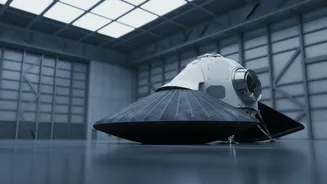
This isn't just a theoretical concept. In November 2022, NASA successfully demonstrated the technology with the Low-Earth Orbit Flight Test of an Inflatable Decelerator (LOFTID) mission. A six-meter diameter inflatable aeroshell was deployed in space, re-entered the atmosphere at over 18,000 miles per hour, and survived the brutal journey. It slowed from Mach 30 to subsonic speeds before splashing down gently under a parachute in the Pacific Ocean. The recovered vehicle was in excellent condition, proving the HIAD technology could withstand the extreme forces and temperatures of re-entry. The test was declared a huge success and showed the technology is ready for future missions.
Built to Survive Fire
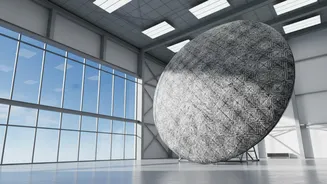
How can a flexible, inflatable object survive temperatures hot enough to melt steel? The answer lies in advanced materials. The outer layer is a flexible thermal protection system made from a woven ceramic fabric, specifically silicon carbide fibers. These fibers can be spun into a yarn and woven like denim on an industrial loom. Beneath this tough outer skin are layers of high-tech insulation, like Pyrogel and Kapton, that prevent the 1,600-degree Celsius heat from reaching the inflatable structure itself. The inflatable part is made of a series of stacked, concentric rings woven from synthetic polymers that are, pound for pound, stronger than steel. This allows the structure to be packed down but remain incredibly rigid and strong when inflated.
Bigger Landings, Bolder Missions
The key advantage of inflatable heat shields is scalability. Because they are not limited by the rocket's launch fairing, they can be made much larger than any rigid shield ever could. This breakthrough enables entirely new mission profiles. For one, it could allow for the recovery of large rocket stages for reuse, significantly lowering the cost of space access. More excitingly, it opens the door to landing much heavier payloads on Mars—think entire human habitats or large-scale robotic explorers. Current technology limits landings to specific, lower-altitude regions of Mars, but a larger decelerator would allow access to higher-altitude landing sites that are currently unreachable. This technology could also be used for missions to Venus or Saturn's moon Titan, or for returning large quantities of manufactured goods from space.