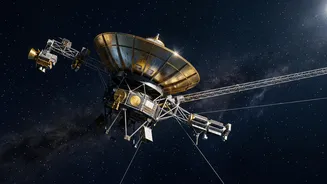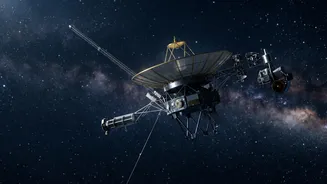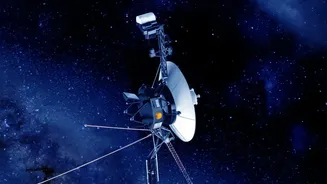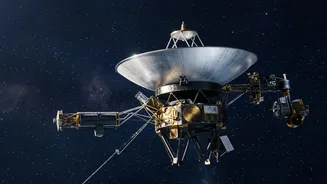




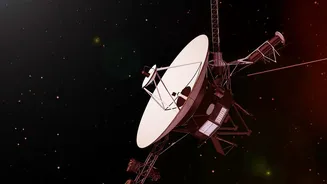
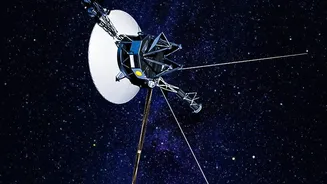
Humanity's farthest emissary is talking again. After a nerve-wracking silence, NASA’s Voyager 1 probe is beaming back valuable science from interstellar space, a triumph of engineering over 24 billion kilometres.
A Silence Across the Stars
For nearly five months, the most distant
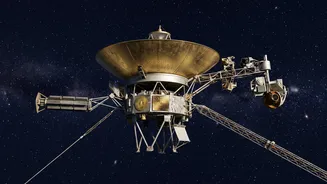
human-made object fell silent. In November 2025, Voyager 1, a relic of the 1970s now cruising through the space between stars, began sending back a stream of gibberish. The probe was clearly still receiving commands, a ghost in the machine that would listen but couldn't reply coherently. The problem was traced to its Flight Data Subsystem (FDS), one of three onboard computers responsible for packaging all the scientific and engineering data before it's sent to Earth. With a one-way signal taking nearly a full day to reach the craft and another day to hear back, troubleshooting became a painstaking exercise in patience and precision.
Cosmic Detective Work
Engineers at NASA's Jet Propulsion Laboratory (JPL) embarked on a remarkable session of long-distance diagnostics. In early 2026, they sent a command, which they called a 'poke', to the spacecraft, instructing the FDS to try different sequences in its software to work around any potential corruption. That command prompted the probe to send back a full memory dump of the FDS. By comparing this data to a readout from before the glitch, the team found the culprit: a single faulty memory chip had failed, corrupting about 3% of the FDS memory and crippling the software within it. It was a hardware problem that would require a software solution of incredible ingenuity, as a physical repair was impossible.
The Ultimate Remote Fix
With the faulty chip identified but beyond repair, the JPL team devised an elegant workaround. Since no single location in the FDS memory was large enough to hold the entire corrupted code, they decided to slice it into sections and carefully distribute them into different, smaller pockets of available memory. This required not only moving the code but also updating all other parts of the system to know where to find these newly relocated pieces. On April 18, 2026, they sent the first part of this complex patch—the code responsible for packaging the spacecraft's own health and status data. After a 45-hour wait, on April 20, readable engineering data flowed back to Earth for the first time in five months, confirming the daring fix had worked.
What the Probe Is Telling Us
With engineering data restored, the team methodically reapplied their fix to the code governing the science instruments. By June 2026, all four of Voyager 1's active instruments were back online, returning usable data. These instruments—studying plasma waves, magnetic fields, and cosmic particles—are our only direct source of information from interstellar space. They are tasting, feeling, and measuring the environment beyond our solar system's protective bubble, the heliosphere. The data they provide offers rare insights into the sparse, mysterious medium that exists between the stars, a region no other active probe has ever reached.
Racing Against the Inevitable
Even as engineers celebrated this recovery, the second part of the headline looms large: power. Voyager 1 is powered by radioisotope thermoelectric generators, which convert heat from decaying plutonium into electricity. After nearly 50 years, that power supply is fading, decreasing by about 4 watts annually. To prolong the mission, NASA has been methodically shutting down non-essential systems and recently performed a complex power-shuffling manoeuvre nicknamed the 'Big Bang' to extend the life of the science instruments. This constant battle against time is a sober reminder that while Voyager 1 has once again been saved by human ingenuity, its historic journey will eventually end, not with a bang, but with a slow, inevitable fade to silence.