




A Celestial Game of Hide-and-Seek
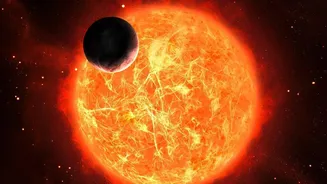
About 1,000 light-years from Earth, in a system designated TOI-2535, a world has gone missing. At least, it has vanished from our view. The planet, known as TOI-2535 b, is a 'hot Jupiter'—a gas giant that orbits its star at a blistering pace, completing
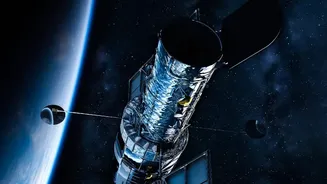
a full year in just over eight days. For seven years, from 2019 to early 2026, NASA's Transiting Exoplanet Survey Satellite (TESS) watched this planet cross in front of its star, an event called a transit. These transits, which cause a tiny, predictable dip in the star's brightness, are a primary method for discovering new worlds. But in 2026, the transit stopped. The planet, from our perspective, simply disappeared.
The Telltale Wobble
Planets don't just vanish, so astronomers knew they were seeing the result of a complex cosmic dance. Even before it disappeared, TOI-2535 b was acting strangely. Its transits weren't happening like clockwork; they were arriving up to six hours early or late. This phenomenon, known as transit timing variation (TTV), is a classic sign that another object's gravity is pulling on the planet, either speeding it up or slowing it down in its orbit. Furthermore, observers noticed the transits becoming shorter and shallower over time. This indicated that the planet's orbit was physically tilting away from our line of sight. The clues pointed to one conclusion: an unseen, massive companion was gravitationally bullying TOI-2535 b.
Meet the Unseen Neighbour: TOI-2535 c
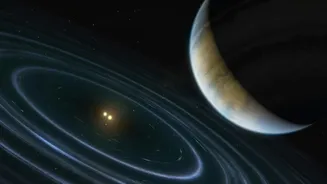
The culprit is believed to be another giant planet in the system, now catalogued as TOI-2535 c. Though it has not been seen directly, its presence is inferred from its powerful influence on its neighbour. Scientists believe this hidden world is also on a tilted orbit relative to TOI-2535 b. This gravitational tug-of-war between the two worlds causes both of their orbits to precess, or wobble, like a spinning top. This slow wobble caused TOI-2535 b's orbit to tilt just enough that it no longer crosses between its star and Earth. The geometry is similar to why we don't have a solar eclipse every month; the Moon's tilted orbit only aligns perfectly with the Earth and Sun occasionally.
Rewriting the Rules of Planet Formation
This discovery does more than solve a celestial disappearance; it challenges our understanding of how planetary systems, especially those with hot Jupiters, form. One popular theory, the 'violent pathway,' suggests hot Jupiters form far from their star and are then flung inwards after a chaotic gravitational encounter. However, such an event would likely have ejected any nearby companions. The presence of a close, massive neighbour to TOI-2535 b suggests a gentler migration, where planets spiral inwards together within the early protoplanetary disk. But that calmer scenario usually results in flat, aligned systems. The significant tilt between these two planets suggests something else happened later to knock them askew, adding a new layer of complexity to the story of planetary evolution.