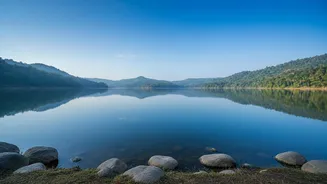







Unearthing a 2,500-Year-Old Climate Record
Scientists from the Birbal Sahni Institute of Palaeosciences (BSIP) in Lucknow have uncovered remarkable evidence from the sediments of Raja Rani Lake in Korba district, Chhattisgarh. By extracting a 40-centimetre sediment core, they accessed an environmental
archive stretching back roughly 2,500 years. This core contains layers of mud that have trapped pollen grains from surrounding vegetation for millennia. The study is significant because Korba lies within India's Core Monsoon Zone (CMZ), a region that receives the vast majority of the country's annual rainfall and is highly sensitive to monsoon fluctuations. The findings provide a rare, high-resolution glimpse into how the climate and landscape of central India have evolved over centuries.
A Stronger Monsoon in Medieval India
The key finding from the pollen analysis, a science known as palynology, challenges previous assumptions. The evidence shows that between roughly 1060 and 1725 CE, central India experienced a significantly stronger and more sustained Indian Summer Monsoon than previously believed. This period coincides with a global warm phase known as the Medieval Climate Anomaly (MCA). During this time, the pollen record indicates a shift from savannah-like grasslands to dense, mixed tropical deciduous forests. The dominance of pollen from forest-loving plants points to a warm, humid climate with intense rainfall, and crucially, no evidence of major dry spells that were thought to have occurred.
The 'Decision': Informing Climate and Agricultural Policy
This is where the ancient dust gains modern-day weight. The "decision" mentioned in the headline refers to critical policy-making around climate change and agriculture. Understanding how the monsoon behaved during a past warm period like the MCA provides invaluable data for modelling future climate scenarios. As the world faces another period of significant warming, these historical analogues are not just theoretical. They can help policymakers make more informed decisions on water management, crop selection, and forestry. For a state like Chhattisgarh, which is heavily reliant on agriculture, knowing how the regional ecosystem responded to intense monsoons can guide strategies for building climate resilience, choosing appropriate crops, and planning for potential shifts in rainfall patterns.
The Power of Palynology
Palynology is the engine driving these insights. By identifying and counting different types of pollen at various depths in the sediment core, scientists can reconstruct the vegetation of the past with remarkable accuracy. A proliferation of grass pollen might suggest a drier, more open landscape, while an abundance of tree pollen points to a dense forest and wetter conditions. These vegetation shifts are powerful proxies for understanding past climate. This technique has been used worldwide to decipher everything from ancient agricultural practices to long-term climatic cycles. The Chhattisgarh study is a powerful example of how this field provides a crucial long-term perspective that modern meteorological records, which only span a century or two, simply cannot offer.