

A New Star Ignites the Sky
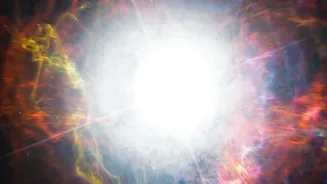
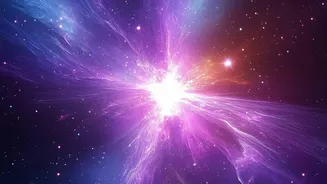
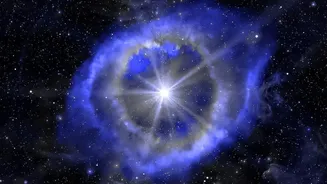
First observed in early October 1604, a 'new star' suddenly appeared in the constellation Ophiuchus, the serpent-bearer. Within weeks, it grew brighter than any star and even outshone the planet Jupiter, becoming so luminous it was visible during the day
for over three weeks. This celestial newcomer, which we now call SN 1604 or Kepler's Supernova, was the last such explosion observed in our own Milky Way galaxy. For skywatchers in the early 17th century, working without telescopes, its appearance was both an awe-inspiring spectacle and a profound mystery. It sparked excitement and debate among astronomers from Italy to Korea, all trying to make sense of the brilliant, uninvited guest in a supposedly unchanging sky.
Kepler and the View from Europe
Although he was not the first to see it, the event became forever linked with the German astronomer Johannes Kepler. Notified by colleagues, Kepler began his meticulous observations on October 17 and tracked the star's behaviour for more than a year. This was a pivotal moment. The dominant belief, inherited from the ancient Greek philosopher Aristotle, was that the heavens beyond the Moon were perfect and immutable. A new star appearing violated this core principle. Just 32 years earlier, Tycho Brahe's observation of a supernova in 1572 had already cast doubt on this idea. Now, Kepler, using careful measurement, demonstrated that the new star showed no parallax—the apparent shift in position of an object when viewed from different locations. This proved it was located far beyond the Moon, deep among the 'fixed' stars. His detailed findings, published in the book 'De Stella Nova' ('On the New Star'), were a monumental work of observational science that further dismantled the old cosmic order.
Whispers from the East
European astronomers were not the only ones recording the event. In China, the Ming court's astronomical bureau noted the 'guest star' and its position. In Korea, royal astronomers provided a remarkably detailed and consistent log of the star's appearance and its fluctuating brightness over several months. These records, while serving different cultural and political purposes—often related to imperial astrology—were incredibly precise. Unlike many European accounts that were tangled in philosophical debate, the East Asian records were often dispassionate and empirical. Centuries later, these independent and meticulous observations from China and Korea would prove invaluable for modern astronomers, helping them reconstruct the supernova's light curve—how its brightness changed over time—with far greater accuracy.
Astrology vs. Astronomy
In the 17th century, astronomy and astrology were deeply intertwined. For many, the new star was not a scientific curiosity but a powerful omen. Astrologers worked to interpret its meaning, as the star appeared near a significant conjunction of the planets Jupiter and Saturn. Kepler himself, who served as an imperial mathematician, was expected to provide astrological interpretations. However, his work on SN 1604 showcases the period's great intellectual shift. While he engaged with astrological ideas, his core focus was on empirical observation and geometric proof. This stood in contrast to the purely interpretive nature of astrology. The supernova became a battleground for ideas: was the universe a stage for divine messaging, or was it a physical realm that could be understood through measurement and rational inquiry? The gradual separation of scientific astronomy from traditional astrology was a key outcome of this era.
The Supernova's Lasting Legacy
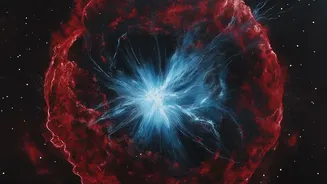
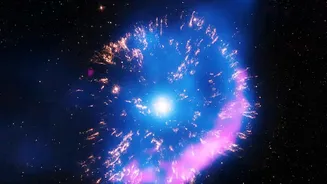
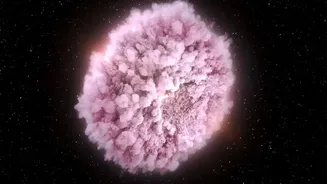
Today, we know that Kepler's 'new star' was not a birth, but a spectacular death. It was a Type Ia supernova, the explosion of a small, dense star called a white dwarf that was part of a binary star system. The historical records from over 400 years ago remain crucial. They have allowed modern scientists to pinpoint the supernova's remnant—the expanding cloud of gas and dust from the explosion—and study it with powerful tools like the Hubble and Chandra space telescopes. These ancient observations provide a vital baseline for understanding the lifecycle of stars, the dynamics of supernova explosions, and how these events enrich our galaxy with the heavy elements necessary for forming planets and life.