








The Challenge of 'Sensor Drift'
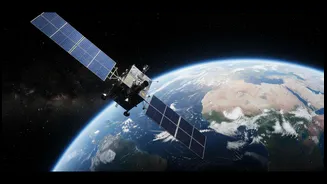
To understand our changing planet, scientists rely on a fleet of Earth-observing satellites. These instruments measure everything from ocean temperatures to cloud cover, providing the data that underpins global climate models. But there's a persistent
problem: over time, the harsh environment of space causes satellite sensors to degrade. This degradation, known as 'sensor drift,' means their measurements can become slightly less accurate. While the error might be minuscule day-to-day, it compounds over years and decades, potentially skewing our long-term understanding of climate trends. It's like trying to measure your height with a tape measure that slowly stretches over time; eventually, you can't be sure if you're growing or if your tool is just getting less reliable. This uncertainty is a significant challenge when the stakes—making multi-trillion-dollar decisions about climate policy and infrastructure—are so high.
An Ultra-Precise Ruler in Space
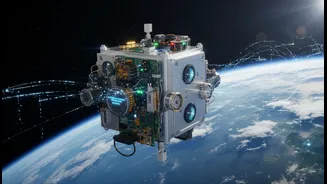
Enter the Climate Absolute Radiance and Refractivity Observatory (CLARREO) Pathfinder, or CPF. Hosted on the International Space Station (ISS), this NASA mission isn't just another weather satellite; it's a metrology lab in orbit. Its primary job is to measure the amount of sunlight that reflects off the Earth with an accuracy that is five to ten times better than any current sensor in space. The instrument, a hyperspectral imager, achieved 'first light' in the summer of 2026, successfully capturing its first detailed science data from orbit. By being so incredibly accurate, CPF serves as a definitive reference point—a 'gold standard' against which all other Earth-observing satellites can be compared. Its measurements are directly traceable to international standards (SI), the same fundamental standards used in laboratories on the ground.
How Calibration Creates Consistency
The key function of CLARREO Pathfinder is intercalibration. Think of it as a master tuner for an orchestra of satellites. As CPF orbits the Earth, its path crosses those of other satellites, like the CERES and VIIRS instruments that are crucial for monitoring Earth's energy budget. During these crossover events, both CPF and the other satellite measure the same spot on Earth at nearly the same time. By comparing the other satellite's reading to CPF's ultra-accurate measurement, scientists can precisely quantify any drift or bias in the other sensor. This allows them to correct the data from the entire fleet of satellites, effectively synchronizing all the different instruments to the same high standard. This process removes the long-term uncertainty caused by individual sensor degradation, making the combined climate record far more robust and trustworthy.
Keeping Itself Honest
But how does the Pathfinder itself avoid sensor drift? The instrument has a clever self-calibration system. On a regular basis, it points away from the Earth to take direct measurements of the Sun and the Moon. Since the Sun is a very stable and well-monitored source of energy, and the Moon is a stable reflector, these celestial bodies serve as unchanging reference points. By constantly checking its own measurements against these known quantities, CPF can detect and correct for any changes in its own sensitivity, ensuring it remains a reliable benchmark throughout its mission. This ability to maintain its high accuracy over time is what makes it a true game-changer for climate science.
From Pathfinder to a Climate Watchtower
As its name suggests, the CLARREO Pathfinder is a demonstration mission, designed to prove the technology and methodology work in space. Launched in May 2026, the one-year mission is the first step toward a potential future constellation of CLARREO satellites. The goal is to establish a permanent, highly accurate climate observing system in orbit that can provide the benchmark data needed to detect climate trends with much higher confidence and on faster timescales. The data from CPF will be made publicly available, helping not only government agencies like NASA and NOAA but also commercial satellite operators improve the accuracy of their own observations. By providing this foundational measurement, CLARREO Pathfinder strengthens the entire global infrastructure for monitoring our planet, ensuring that the critical data we rely on is as accurate as possible.