







A World We Never Expected
Before 2015, our best images of Pluto were blurry pixels from the Hubble Space Telescope. Scientists expected the New Horizons spacecraft to find a geologically dead world, frozen solid and battered with craters over billions of years. After all, small
worlds so far from the Sun should have lost their internal heat long ago. What New Horizons found instead was a stunning shock. Pluto is a world of incredible complexity, featuring vast glaciers, towering mountains made of water ice, and a surprisingly young surface. This discovery forced scientists to completely re-evaluate the rules of planetary science, proving that a small body could remain active billions of years after its formation.
The Beating Heart of a Dwarf Planet
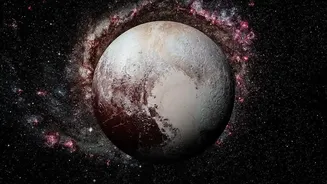
The most stunning feature is Sputnik Planitia, the western lobe of Pluto's famous heart-shaped region. This is not solid ground, but a colossal glacier of frozen nitrogen, larger than Texas and Oklahoma combined. The surface of this glacier is divided into city-sized cells that show clear signs of convection, meaning the nitrogen ice is churning and overturning like a slow-motion boiling pot. This constant resurfacing is why the area is almost completely free of impact craters; its surface is geologically young, estimated to be less than 10 million years old. Recent analysis even suggests liquid nitrogen may be welling up from beneath the ice sheet, briefly wetting the surface before refreezing.
Ice Volcanoes and Hidden Oceans
Beyond the flowing glaciers, Pluto shows evidence of even more dramatic activity: cryovolcanism. Unlike Earth's volcanoes that spew molten rock, cryovolcanoes erupt a slushy mix of water, ammonia, and other icy materials. Researchers have identified several large mounds, including the prominent Wright Mons, that appear to be giant ice volcanoes. Some of these features seem to have been active in the geologically recent past, suggesting Pluto's interior is warmer than previously thought. The leading theory is that Pluto may harbor a vast liquid water ocean beneath its thick ice shell. The slow freezing of this ocean, combined with heat from the decay of radioactive elements in its core, could provide the energy needed to power this unexpected geological dynamism.
Rewriting the Rules for Icy Worlds
Pluto's surprising vitality has profound implications that extend far beyond the dwarf planet itself. It serves as a powerful argument that other small, icy bodies in the Kuiper Belt—the solar system's distant third zone—could also be much more complex than once assumed. If a small world like Pluto can retain enough internal heat to power glaciers and cryovolcanoes, then it challenges the old checklist for what makes a world interesting. It suggests that the key ingredients for geological activity, and perhaps even for harboring life-sustaining liquid water, might be more common in the universe than we believed. Pluto has transformed from a simple endpoint of the solar system into a gateway to understanding a whole new class of active, evolving worlds.