



A New Eye on Stellar Nurseries
Before the JWST, our view of stellar nurseries — the vast, cold clouds of gas and dust where stars are born — was often obscured. Much like trying to see through a dense fog, visible light telescopes couldn't penetrate the thick dust. Webb, however, is designed
to see in infrared light. This allows it to peer through the cosmic dust and witness the processes of star formation that were previously hidden. Recent observations have targeted regions where galaxies or massive gas clouds are colliding, providing an unprecedented look at how these chaotic events shape the universe.
The Cosmic Car Crash
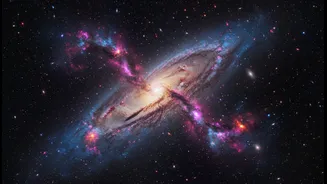
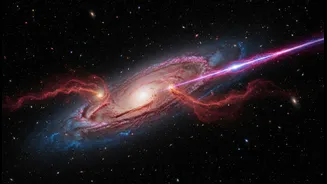
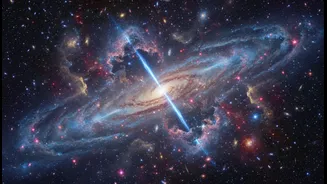
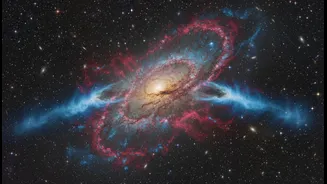
One of the most exciting new findings comes from observations of galactic collisions. For a long time, astronomers have theorized that when galaxies collide, the interaction can trigger a massive burst of star formation, known as a starburst. The gravitational forces involved in these mergers can cause huge shockwaves to ripple through clouds of interstellar gas. These shockwaves compress the gas and dust, creating dense pockets that can collapse under their own gravity to form new stars. The JWST has recently provided some of the clearest evidence yet of this process in action, observing galaxies like Centaurus A and M82, where collisions are actively fueling new stellar nurseries.
Putting the Pedal to the Metal
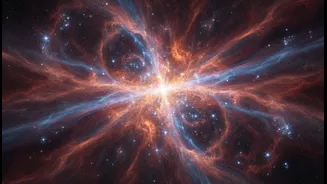
The key takeaway from these new observations is speed. The traditional model of star formation is a relatively slow and steady process, taking place over millions of years as a molecular cloud gradually condenses. However, Webb's data suggests that interstellar collisions can dramatically shorten this timeline. The intense compression from shockwaves can trigger a rapid, simultaneous burst of star formation across a huge region. Instead of a slow burn, it's a cosmic firework display. This challenges previous models, suggesting star formation in some environments can be far more violent, rapid, and efficient than we thought.
Rethinking the Early Universe
This has profound implications for our understanding of the early universe. One of the puzzles presented by Webb's deep-field images is the presence of massive, well-formed galaxies much earlier in cosmic history than models predicted. If star formation can be supercharged by collisions, which were more common in the crowded early universe, it could help explain how these first galaxies grew so big, so fast. Recent Webb studies have found evidence of massive galaxies in the young universe that had already stopped forming stars, a process known as quenching. Understanding that collisions can rapidly spark and then potentially exhaust a galaxy's gas supply provides a crucial piece of this puzzle.
From Protostars to Planets
The impact of these cosmic collisions isn't just about the stars themselves. The environment in which a star is born affects the entire planetary system that may form around it. Rapid star formation can alter the chemical composition and distribution of the protoplanetary disk — the spinning platter of dust and gas from which planets are made. Webb has already started to detail the complex organic molecules and ices found in these star-forming regions, the very building blocks for life. Understanding the initial conditions of a star's birth is the first step in understanding the potential for habitable worlds to emerge around it.