

Catch the Final Perseid Meteors
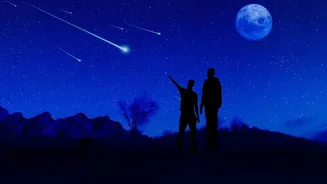
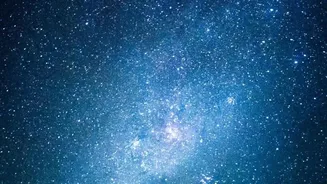
While the famous Perseid meteor shower had its peak around August 12-13, it remains active until about August 24. In the second half of the month, you can still catch some of these shooting stars, which are pieces of debris left behind by Comet Swift-Tuttle.
Though the rate will be lower than the peak's 50-100 meteors per hour, you can still spot bright, fast meteors in the late hours. For your best chance, find a location far from city lights, let your eyes adjust to the darkness for at least 30 minutes, and look towards the northeast. The hours between midnight and dawn are prime viewing time.
The Brilliance of Venus in the Evening
Throughout August, the planet Venus is a dominant and unmissable presence in the early evening sky. After sunset, look to the west to find this incredibly bright planet. Around August 15, Venus reached its greatest eastern elongation, meaning it was at its highest point above the horizon for the year, making it particularly easy to spot. On the evenings of August 16 and 17, the waxing crescent Moon can be seen near Venus, creating a beautiful pairing in the twilight. You don't need any special equipment; its brightness makes it stand out effortlessly.
A Parade of Morning Planets
If you're an early riser, the pre-dawn sky offers a showcase of several planets. Throughout the end of the month, you can spot reddish Mars and yellowish Saturn in the eastern sky before sunrise. Mars will be visible near the constellation Gemini, while bright Jupiter will also be making an appearance low on the eastern horizon. Though some planets like Uranus and Neptune require binoculars or a telescope, Mars and Saturn are easily visible to the naked eye, offering a rewarding sight for those who look up before the sun appears.
A Deep Partial Lunar Eclipse
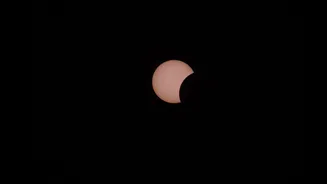
Mark your calendars for the night of August 27-28 for a significant celestial event: a deep partial lunar eclipse. During this event, the Full Moon will pass through Earth's dark shadow, with about 96% of its face being covered at the peak. This will cause a large portion of the Moon to darken considerably, and it may even take on a reddish hue, an effect often called a 'Blood Moon'. The event culminates in the early hours of August 28, with the Full Moon officially occurring at 04:19 UTC. While a partial eclipse on this date will happen, its visibility from India is not confirmed, but it will be viewable in other parts of the world and likely streamed online.
Saturn and the Moon Close the Month
As August comes to a close, look for the Moon to pair up with the ringed planet, Saturn. On the evenings of August 29 and 30, the waning gibbous Moon will appear near Saturn in the sky. Saturn rises in the east in the evening and will be visible for the entire night, making it an easy target. While its famous rings require a telescope to be seen, the planet itself is visible to the naked eye as a steady, yellowish point of light. This celestial pairing provides a lovely and serene sight to bid farewell to the month's stargazing opportunities.