



A Signal Becomes Gibberish
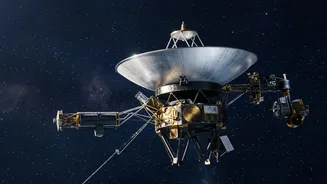
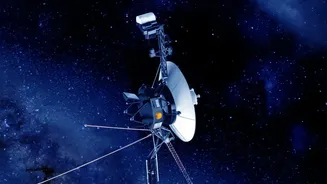
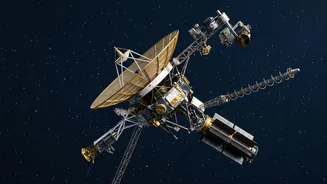
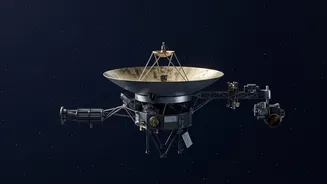
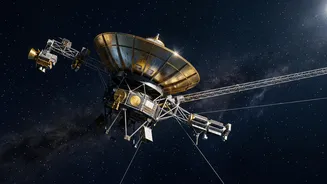
In November 2023, the steady stream of data from Voyager 1, which has been exploring space since 1977, suddenly turned into an indecipherable, repeating pattern. The probe was still receiving commands, but the vital science and engineering data it was sending
back from interstellar space—more than 24 billion kilometers away—was unusable. Engineers at NASA’s Jet Propulsion Laboratory (JPL) faced a daunting task: diagnosing and fixing a computer glitch on a spacecraft so far away that a single message takes nearly 23 hours to reach it, meaning a round-trip conversation requires 45 hours. The problem was traced to the Flight Data Subsystem (FDS), one of three computers onboard, which is responsible for packaging data for transmission to Earth.
An Ingenious Long-Distance Repair
After months of troubleshooting, the JPL team confirmed that a single memory chip in the FDS had failed, corrupting about 3% of its memory. Since a physical repair was impossible, engineers devised a clever workaround. They decided to slice up the affected code and store it in different locations within the FDS memory, a delicate operation on a system with less than 70 kilobytes of memory in total. In April 2024, the team sent the commands to relocate the code. On April 20, they received a signal confirming the fix had worked: for the first time in five months, Voyager 1 was sending back clear data on its health and status. By June, all four of its active science instruments were once again returning usable data from interstellar space.
A Milestone Measured in Light
The successful recovery comes as Voyager 1 approaches a monumental milestone. On November 18, 2026, the spacecraft will become the first human-made object to reach a distance of one light-day from Earth. A light-day is the distance light travels in 24 hours, equivalent to about 25.9 billion kilometers. While the spacecraft itself will not detect anything new, the achievement underscores the immense scale of its journey and the endurance of 1970s technology. This milestone also highlights the communication challenge: at that distance, a signal sent from Earth will take a full day to arrive, and another day will pass before a response is received.
The Constant Battle for Power
Keeping Voyager 1 alive is a constant race against time. The spacecraft is powered by radioisotope thermoelectric generators (RTGs), which convert heat from decaying plutonium into electricity. However, this power source weakens over time, losing about four watts of power each year. To conserve every precious watt, engineers have been forced to make difficult decisions, systematically shutting down non_essential systems and even heaters for science instruments. In a recent power_saving effort nicknamed the 'Big Bang', engineers simultaneously swapped several components for lower_power alternatives to keep the spacecraft warm enough to operate and delay shutting down another science instrument. These measures are critical to extending the mission's life for as long as possible.