

The Cosmic Middle Child
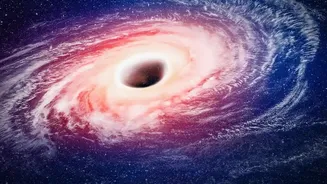
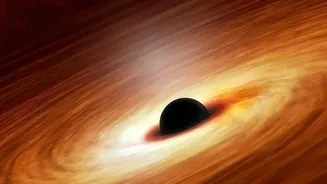
In the cosmic family album of black holes, astronomers long had clear pictures of only two types. First are the stellar-mass black holes, typically 5 to 50 times the mass of our Sun, formed from the collapse of massive individual stars. On the other end
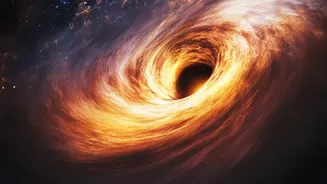
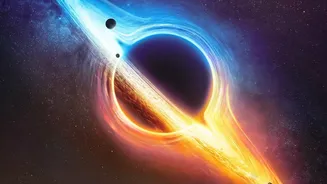
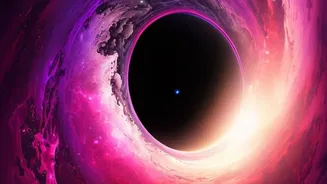
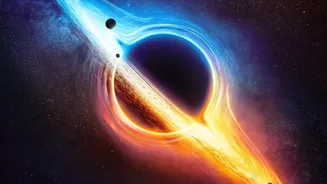
of the spectrum are the supermassive black holes (SMBHs), behemoths lurking at the center of galaxies, including our own Milky Way, with masses ranging from millions to billions of suns. For years, the gap between these two categories was a profound mystery. Scientists theorized the existence of Intermediate-Mass Black Holes (IMBHs), those with masses from a hundred to a hundred thousand suns, but finding them proved incredibly difficult. They were the universe's missing link, crucial for understanding how the cosmic giants—the SMBHs—could have possibly grown so large in the age of the universe.
Ripples in the Fabric of Spacetime
The breakthrough came not from seeing these black holes, but from hearing them. Or, more accurately, from detecting the infinitesimal ripples they create in the fabric of spacetime itself. When two black holes spiral into each other and merge, they release an immense burst of energy in the form of gravitational waves. Observatories like the Laser Interferometer Gravitational-Wave Observatory (LIGO) in the United States and the Virgo detector in Italy are designed to detect these faint tremors. By analyzing the precise shape and frequency of a gravitational wave signal, scientists can deduce the masses of the objects that created it. This technology gave astronomers a revolutionary new tool to observe the universe's most violent and invisible events.
A Landmark Collision
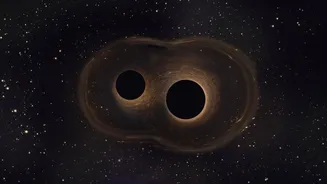
A pivotal moment arrived with the detection of an event named GW190521. On May 21, 2019, LIGO and Virgo captured a brief, powerful signal from about 7 billion light-years away. The analysis was stunning: it was the death spiral of two black holes, with masses around 85 and 66 times that of the Sun. What made this event so special was the resulting object. After radiating away energy equivalent to eight suns, the final merged object weighed in at 142 solar masses. This placed it squarely in the IMBH category, making it the first clear-cut, unambiguous detection of a black hole of this type at the moment of its birth. This single event moved IMBHs from the realm of theory to concrete observation.
Rewriting the Story of Growth
The confirmation of IMBHs provides a powerful solution to the "seeding" problem for supermassive black holes. How did SMBHs get so big, so fast? One leading theory is hierarchical growth: small things merge to make bigger things. The detection of GW190521 and subsequent candidates demonstrates that this process happens. Stellar-mass black holes merge to form IMBHs. These IMBHs, in turn, can continue to merge with other black holes or consume stars and gas, growing larger over cosmic time. They act as the seeds or building blocks that, through a series of mergers and accretion over billions of years, can eventually grow into the supermassive giants that dominate the centers of galaxies. This provides a much more plausible and step-by-step pathway for cosmic evolution than a model where SMBHs had to form directly from colossal clouds of primordial gas, a process that is difficult to explain.
Solving the Galaxy Puzzle
Beyond explaining the growth of the biggest black holes, IMBHs also help us understand the evolution of galaxies themselves, especially smaller ones. While massive galaxies like the Milky Way have a supermassive black hole at their core, many dwarf galaxies appear to lack such a central engine. Some astronomers now believe that IMBHs could be the central black holes for these smaller galaxies. Finding more of these objects could solidify the link between a galaxy's evolution and the mass of its central black hole, a relationship that seems to hold true for larger galaxies. As our gravitational wave detectors become more sensitive, they will be able to detect more, and more distant, IMBH mergers. Each new detection will be another piece of the puzzle, helping us map the complete life cycle of black holes and the galaxies they call home.