




A Day Longer Than A Year
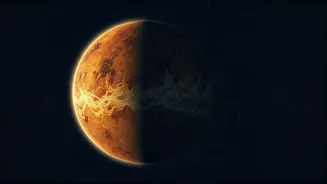
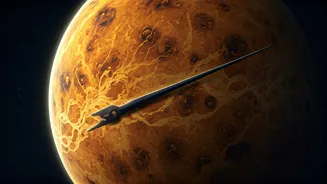
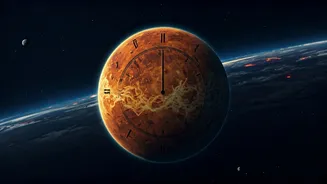
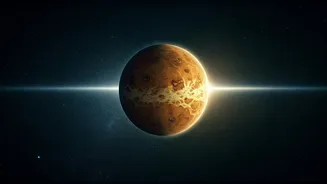
Let's start with the mind-bending numbers. Venus takes about 225 Earth days to complete one full orbit around the Sun. That’s its year. However, it takes a staggering 243 Earth days for Venus to complete just one full rotation on its axis. This is what
astronomers call a sidereal day. So, if you were standing on Venus, a single spin of the planet beneath your feet would take longer than your entire journey around the Sun. This simple fact makes Venus a true outlier in our solar system and begs the question: how did our neighbour get so strange?
The Planet That Spins Backwards
One of the first clues to Venus's temporal weirdness is its rotation. Nearly every planet in our solar system, including Earth, spins on its axis in a counter-clockwise direction (prograde motion). This is the same direction they orbit the Sun. Venus, however, does the opposite. It has a retrograde rotation, meaning it spins clockwise. Scientists believe this could be the result of a cataclysmic event deep in its past. One leading theory suggests that a massive asteroid or planetoid slammed into a young Venus, sending it spinning in the opposite direction. While this explains the backward motion, it doesn't fully account for why the spin is so incredibly slow.
An Atmosphere With A Vengeance
The real culprit behind Venus’s lethargic spin is its atmosphere. To call it 'thick' is an understatement. The Venusian atmosphere is about 90 times denser than Earth's, composed almost entirely of carbon dioxide with clouds of sulfuric acid. This creates a runaway greenhouse effect, leading to surface temperatures hot enough to melt lead. But this dense blanket of gas does more than just heat the planet; it moves. The upper atmosphere of Venus 'super-rotates,' whipping around the planet once every four Earth days. This is a blistering pace compared to the planet's 243-day rotation, creating immense friction and atmospheric tides.
The Great Atmospheric Brake
Think of the Venusian atmosphere as a powerful brake being constantly applied to the planet. As the Sun's gravity pulls on this thick, fast-moving atmosphere, it creates powerful tidal forces. These are similar to how our Moon creates ocean tides on Earth, but on a much grander scale. This atmospheric tide drags against the solid surface of the planet. Over billions of years, this constant friction has slowed Venus's rotation to its current crawl. Recent observations by space probes have confirmed that this exchange of momentum between the solid planet and its churning atmosphere is the dominant force governing the length of a Venusian day. The atmosphere is literally stealing the planet's rotational energy.
What About Sunrise to Sunrise?
This is where things get even stranger. While a full rotation (sidereal day) is 243 Earth days, the time from one sunrise to the next (a solar day) is 'only' about 117 Earth days. How can this be? It's because of the planet's backward spin. As Venus slowly rotates clockwise, it's also orbiting the Sun counter-clockwise. This means that a spot on the surface doesn't have to complete a full 360-degree turn to see the Sun in the same position again. The planet's orbital motion gives it a 'head start' in catching up to the Sun each day. This combination of an extremely slow retrograde spin and its orbital path results in a solar day that is shorter than both its sidereal day and its year. So on Venus, you’d experience roughly two sunrises per year.