




A Postcard from the Future
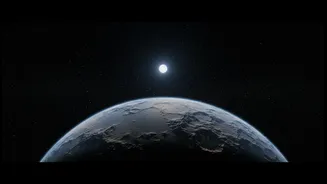
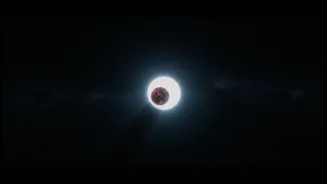
Astronomers have found what is essentially a ghost of a solar system, and it looks surprisingly familiar. About 80 light-years away, a gas giant planet named WD 1856 b orbits the tiny, dead core of its former star. This dead star, a white dwarf, is what remains
after a Sun-like star exhausts its fuel and collapses. What makes this system so compelling is that it acts as a direct analogue for what scientists predict will happen to our own solar system in about five billion years. It is, as one astronomer noted, like using a time machine to look into our own future.
A Story of Death and Survival
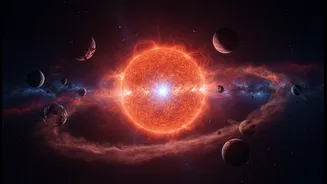
Most stars, including our Sun, will end their lives in a two-act play of destruction and quiet retirement. First, the star swells into a red giant, a phase where its outer layers expand catastrophically, engulfing and destroying any inner planets. For our solar system, this means Mercury and Venus are doomed, and Earth will likely be burnt to a cinder, if not swallowed whole. After this violent expansion, the star sheds its outer layers and collapses into a dense, Earth-sized core called a white dwarf, which slowly cools over billions of years. The puzzle for astronomers was how WD 1856 b survived. It orbits its white dwarf every 34 hours, a proximity that would have meant certain destruction during the red giant phase.
Webb Deciphers a Cosmic Oddity
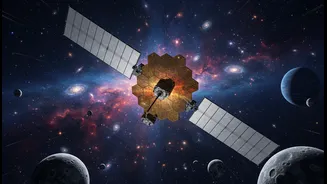
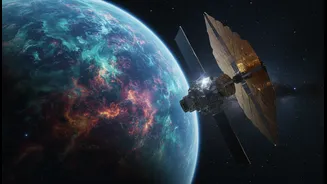
Using the powerful infrared vision of the James Webb Space Telescope (JWST), scientists were able to study the atmosphere of WD 1856 b as it passed in front of its tiny star. This was the first time an atmosphere has been detected on a planet orbiting a white dwarf. The data revealed the presence of methane and hazy clouds. More surprisingly, the planet was much warmer than expected, registering about 126 degrees Celsius. This residual heat became the clue to solving the mystery of its survival. The planet couldn't have been in its current tight orbit when the star died; it must have migrated inward much later.
The Great Planetary Migration
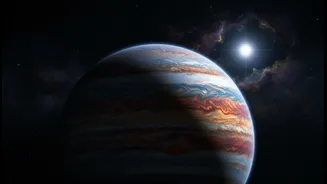
The most plausible explanation is that WD 1856 b, a gas giant similar in size to Jupiter, originally existed in a much safer, distant orbit. Billions of years after its star became a white dwarf, something—perhaps gravitational nudges from other surviving bodies in the system—sent the planet on a new path spiraling inward. As it drew closer to the dense white dwarf, the immense gravity squeezed and flexed the planet, generating intense internal heat—the source of the warmth Webb detected. This journey confirmed that giant planets can not only survive their star's death but can also dramatically reshuffle their positions afterward.
Our Solar System's Inheritance
This discovery provides the strongest evidence yet that the giant planets of our own solar system—Jupiter, Saturn, Uranus, and Neptune—will likely survive the Sun's demise. While the inner solar system faces annihilation, the outer planets will continue to orbit the faint, cooling white dwarf that was once our Sun. Their orbits will likely widen as the Sun loses mass, but they will endure in the cold darkness. The system of WD 1856 b shows us that stellar death is not a complete ending. For some worlds, it's the beginning of a second, very different, life. As one researcher put it, "stellar death is not the end—some planets experience a vibrant and lively future."