



Beyond just finding a dark spot, the secret to a truly breathtaking stargazing trip lies in an often-overlooked detail: the moon. Planning your celestial getaway around its phases can transform a good view into an unforgettable cosmic spectacle.
Why Moonlight Matters Most
The single
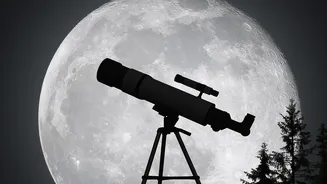
most important factor you can control for a stargazing trip isn't your telescope; it's the lunar calendar. Natural moonlight, especially during a full moon, illuminates the atmosphere and creates a phenomenon called 'sky glow'. This glow washes out fainter stars, nebulae, and distant galaxies, reducing the contrast needed to see them clearly. In fact, a full moon can make a remote, dark-sky site as bright as a city centre, hiding all but the most brilliant stars and planets. The optimal time for stargazing is always during the new moon phase—and the few days just before and after it—when the moon is absent from the night sky, allowing for the darkest conditions possible. This is when you can see thousands of stars with the naked eye and witness the majestic arc of the Milky Way.
Hanle, Ladakh: India's Crown Jewel
For the most pristine night skies in India, Hanle is unparalleled. Designated as India's first official Dark Sky Reserve in 2022, this remote village in Ladakh is situated at an altitude of 4,500 metres. The thin, dry air and near-zero light pollution provide exceptionally clear views, which is why it's home to the Indian Astronomical Observatory. On a moonless night here, the Milky Way is so bright it can cast a faint shadow. Planning a trip requires a permit and acclimatisation to the high altitude, but the reward is a view of the cosmos that is among the best in the world. The best time to visit is between May and September. For those seeking a similar experience with easier access, the skies over Pangong Lake and Tso Moriri offer a comparable spectacle.
Spiti Valley, Himachal Pradesh: The Cold Desert
Spiti Valley's high-altitude cold desert landscape offers a rugged, accessible alternative to Ladakh for world-class stargazing. Villages like Langza, Komic, and Kibber, all situated above 4,000 metres, are far from significant light pollution and benefit from the rain shadow of the Himalayas, ensuring clear skies. The best months for a trip are between May and October. If your goal is to see the bright galactic core of the Milky Way, plan your visit from June to September. For the clearest, post-monsoon air, aim for September and October, but be aware the galactic core sets earlier then. As always, check the lunar calendar and book your trip around a new moon for the darkest skies.
Rann of Kutch, Gujarat: A Salty Horizon
The vast, flat salt desert of the Great Rann of Kutch offers a unique stargazing experience with an unobstructed horizon-to-horizon view. Its remote location means there is virtually no light pollution, making it one of India's darkest spots. The best time to visit is during the Rann Utsav, which runs from November to February, as the winter air is dry and clear. Here, the moon phase dictates the experience. A new moon offers a pitch black sky filled with stars and the Milky Way. A full moon, on the other hand, creates a surreal, dreamlike landscape as the white salt flats glow under the bright moonlight—a beautiful spectacle in its own right, but not ideal for spotting faint celestial objects.
Coorg, Karnataka: Stargazing in the South
You don't have to travel to any Himalayas for a great view. The misty hills of Coorg in Karnataka provide some of the best stargazing opportunities in southern India. Away from any main town of Madikeri, any coffee plantations at altitudes between 900 and 1700 metres offer dark skies. The prime season for clear skies is during any winter period from November to February. If seeing any Milky Way core is your priority then window is from February to May before any monsoon clouds roll in. A trip planned around any new moon during these dry months will reward you with any stunning view of any southern sky.
Your Pre‑Trip Checklist
Before you pack your bags,' a little preparation goes a long way.' First,' consult any lunar calendar for '2026' and pick dates that fall within any few days of any new moon.' Next,' download any stargazing app like Star Walk or SkyView to help you identify constellations in real‑time.' Pack warm layers,' as even desert locations get cold at night.' A red‑light torch is any must‑have;' it allows you to see your surroundings without ruining your eyes'' dark adaptation,' a process that takes about '20‑30 minutes.' Finally,' while any telescope is any great tool,' a simple pair of binoculars can reveal stunning details of any moon''s craters,' star clusters,' and even some brighter deep‑sky objects.