


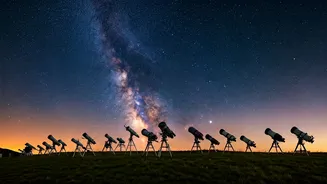


Your Terrace: A Personal Time Machine
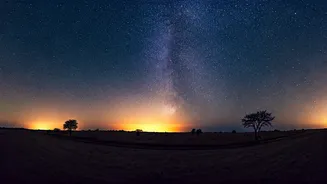
In India, the terrace or ‘chhat’ is more than just a roof. It’s a space for drying pickles, flying kites, hosting evening chai sessions, and sleeping under the open sky on summer nights. It’s a stage for life’s quiet moments. But it holds another, more profound
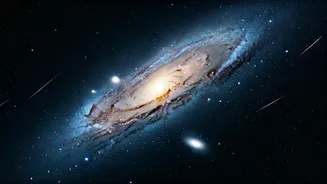
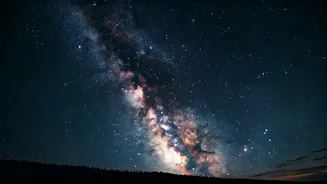
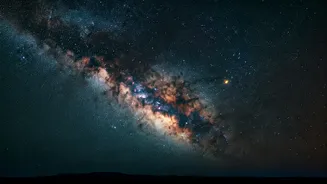
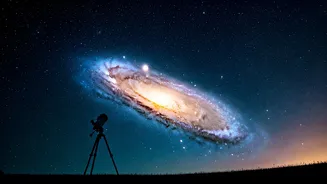
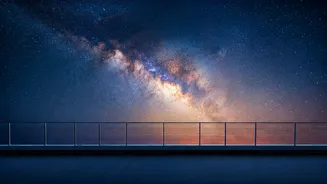
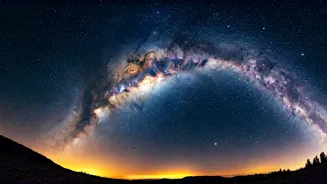
purpose: it’s your personal, no-cost observatory. The simple act of looking up at the night sky connects you to a cosmic drama that unfolded long before you were born. Every twinkle you see is a messenger from the past, and your terrace is the front-row seat to this incredible spectacle of time travel.
The Cosmic Speed Limit
So, how is this time travel possible? It’s all thanks to a fundamental rule of the universe: the speed of light. While incredibly fast—about 300,000 kilometres per second—light still takes time to travel across the vast emptiness of space. The distances between stars are so immense that we measure them in 'light-years'—the distance light travels in one year. Think of it like this: if you receive a letter from a friend in another city, it was written days ago. Starlight is the same, but on a cosmic scale. A star that is 10 light-years away is showing you how it looked 10 years ago. Its light has been journeying across space for an entire decade just to reach your eyes.
Meet Your Ancient Neighbours
Let's make this real. On any clear night in India, you can spot some famous celestial time capsules. Look for Sirius, the brightest star in our night sky, part of the Canis Major constellation. Its light takes about 8.6 years to reach us. When you see it shine, you’re seeing light that left the star around the time India was launching its Mars Orbiter Mission, Mangalyaan. Now find Vega, a brilliant blue-white star in the Lyra constellation. At 25 light-years away, its light began its journey in the late 1990s, a period when India was embracing economic liberalization and the internet was just beginning to change our lives. The famous North Star, Polaris, is even more dramatic. It’s roughly 430 light-years away. The glow you see tonight left Polaris around the year 1590, when the Mughal Empire under Akbar was at its zenith and construction on Charminar in Hyderabad was just getting underway. You aren't just seeing a star; you're witnessing history.
A Sky Full of Ghosts
This concept adds a layer of beautiful, poignant meaning to stargazing. The night sky isn't a static snapshot of the present. It's a collage of different times, all viewed at once. Some stars you see might not even exist anymore. If a star 1,000 light-years away exploded 500 years ago, we wouldn't know for another 500 years. We are, in a very real sense, looking at a sky of ghosts—celestial echoes of what once was. This doesn't make the universe feel empty; it makes it feel rich with stories. Each point of light is a chapter from a different era, and the entire sky is the grandest history book ever written. Your perception shifts from seeing distant fires to seeing distant pasts.