







What Exactly Is Microgravity?
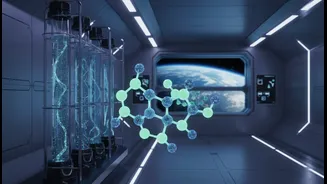
First, let's clear up a common misconception. Microgravity is not 'zero gravity'. Gravity exists everywhere in space, but in orbit, a spacecraft and everything inside it are in a constant state of freefall around the Earth. This creates a condition of near-weightlessness.
Imagine being in an elevator when the cable snaps—for a few terrifying seconds, you would feel weightless. Now, imagine that feeling lasting for months. That continuous freefall is what allows scientists to observe how things behave without gravity's dominant influence. Processes that are masked or distorted by gravity on Earth, like sedimentation (denser materials settling) and convection (hot fluids rising), largely disappear. This reveals underlying physical and biological behaviours that are impossible to study on the ground.
A Laboratory Unlike Any on Earth
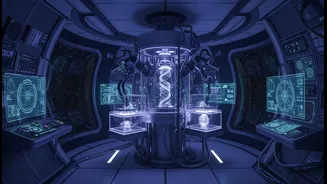
Removing gravity from the equation opens up a world of possibilities. In materials science, it allows for the creation of perfectly mixed metal alloys or higher-quality crystals for use in electronics and pharmaceuticals. In medicine, it's a game-changer. On Earth, cell cultures grow in flat, two-dimensional layers at the bottom of a petri dish. In microgravity, they can form complex 3D structures that more closely resemble how tissues grow in the human body. This provides a much more accurate model for studying diseases like cancer and testing the effectiveness of new drugs. From understanding muscle atrophy and bone loss to developing better life-support systems, space provides a unique laboratory for breakthroughs that have direct applications back on Earth.
ISRO's Push into the Microgravity Frontier
ISRO is making microgravity research a national priority. As part of its Gaganyaan human spaceflight programme, India is not just sending astronauts to space but also empowering its scientific community. The upcoming missions will serve as platforms for a host of experiments designed by Indian researchers. ISRO recently held a national workshop to build a sustainable microgravity research ecosystem, bringing together over 270 experts from academia, industry, and startups. Initiatives like the Indian Microgravity Experiments (IMEx-2026) are actively inviting proposals for research in areas ranging from space biology and pharmacology to in-space manufacturing. Through a collaborative mission with Axiom Space, an Indian astronaut has already conducted seven key experiments aboard the International Space Station (ISS), studying everything from muscle cell regeneration to the growth of moong and methi seeds in space.
From Space Sprouts to Better Medicines
The experiments being conducted are far from abstract. The study on how sprouts grow in space could help develop food systems for long-duration missions and improve agriculture in extreme environments on Earth. Another experiment on microalgae and cyanobacteria explores their potential as a sustainable food and oxygen source for astronauts. On the medical front, research into how muscles deteriorate in microgravity could lead to treatments for age-related muscle loss here on Earth. By studying the behaviour of drug components in space, companies can design more effective and stable medicines. Even research into how astronauts interact with touchscreens helps design better interfaces for high-stress jobs like aviation and emergency response on the ground.
The Next Steps: A Station and a Space Economy
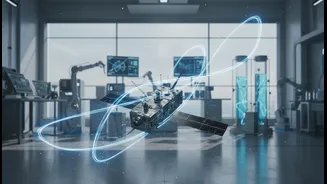
The current push is just the beginning. India has ambitious plans, including establishing the Bharatiya Antariksh Station (BAS) by 2035 and a crewed lunar mission by 2040. A permanent space station will provide a long-term platform for continuous research. This vision is not just about scientific discovery but also about economic opportunity. The global interest in microgravity research is surging, with private companies like Varda Space Industries already demonstrating the viability of in-space manufacturing. By fostering a domestic ecosystem through collaborations with institutions like IIT Madras, which is pioneering research in space welding and manufacturing, ISRO is positioning India to become a key player in this emerging off-planet economy.