




The Universe According to the Old Rules
Until recently, the story of the universe's first billion years seemed straightforward. According to the leading theory, known as the Lambda-Cold Dark Matter (ΛCDM) model, everything started small. After the Big Bang 13.8 billion years ago, tiny fluctuations
in density allowed dark matter to clump together, creating gravitational wells. These wells then slowly captured the surrounding gas, which gradually formed the first stars and small galaxies. Over billions of years, these small galaxies would merge again and again, growing into the majestic spirals and massive elliptical galaxies we see today. This bottom-up process was thought to be a slow and steady cosmic construction project. Early galaxies were expected to be small, messy, and structurally simple. It was a neat theory that explained many features of our modern universe.
Webb's Game-Changing Gaze
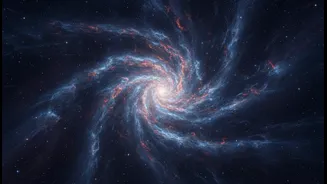
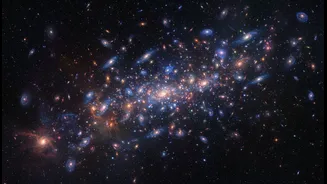
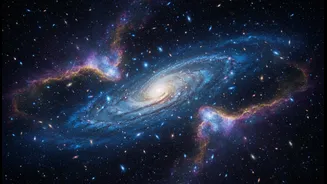
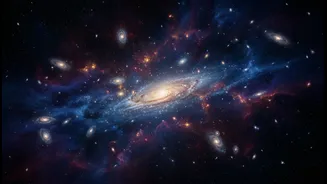
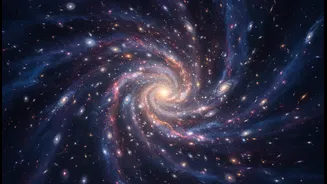
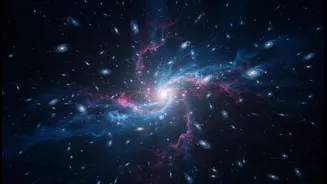
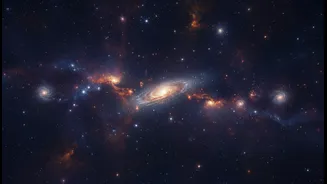
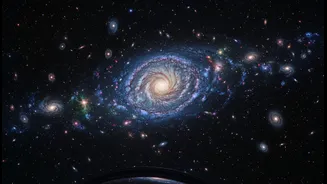
Enter the James Webb Space Telescope (JWST). With its unparalleled infrared sensitivity, Webb was designed to peer back to this 'Cosmic Dawn,' the period just a few hundred million years after the Big Bang. What it found has sent shockwaves through the astronomical community. Instead of small, simple proto-galaxies, Webb has revealed objects that are astonishingly massive and mature. Several studies have identified galaxies that existed just 300 to 600 million years after the Big Bang, yet already rivaled the mass of our own Milky Way. Some even show complex structures like stellar bars and dense nuclear disks, features once believed to have taken billions of years to form. These discoveries have been nicknamed 'universe breakers' because they directly challenge the timeline predicted by our standard cosmological model.
A Cosmic Conundrum
The existence of these 'impossibly early' galaxies presents a major puzzle for scientists. The core of the problem is time. According to the ΛCDM model, there simply wasn't enough time for these galaxies to accumulate so much mass so quickly. The universe's raw materials—hydrogen and helium gas—should have taken much longer to be gathered and converted into stars on such a grand scale. One recent discovery identified a galaxy with a star formation rate 180 times that of the Milky Way, hinting at a process far more efficient than previously imagined. This implies one of two things: either the early universe was far better at building galaxies than we thought, or the fundamental rules of our cosmological model need a major revision.
Rewriting the Cosmic Playbook
This flood of new data has triggered a flurry of theoretical activity as scientists scramble to explain how these structures could exist. Is the standard model of cosmology incomplete? Some theories propose that star formation in the early universe was incredibly efficient, perhaps driven by a different type of massive, hot primordial star than those that form today. Others suggest a more radical departure, questioning our understanding of dark matter or proposing that the 'seeds' of supermassive black holes were present from the very beginning, acting as gravitational anchors that accelerated galaxy growth. The findings are forcing a re-evaluation of everything from how the first stars were born to the very nature of cosmic expansion. While some early, dramatic claims of 'breaking cosmology' have been tempered, the consensus is that our understanding of galaxy formation needs a significant update.