
Decoding Alien Atmospheres with Light
At the heart of these discoveries is a technique called transmission spectroscopy. Think of it as analysing a cosmic barcode. When an exoplanet passes in front of its host star from our perspective, a tiny fraction of the starlight filters through the planet's
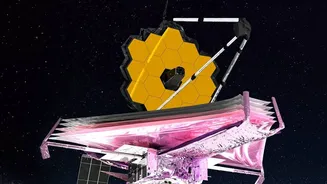
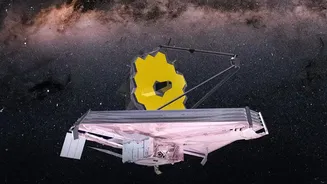
atmosphere. The gases in that atmosphere absorb specific colours, or wavelengths, of light. The James Webb Space Telescope's powerful instruments can detect these missing colours, creating a spectrum that reveals the chemical fingerprints of molecules like water vapour, methane, and carbon dioxide. This allows scientists to determine what an exoplanet's atmosphere is made of, hundreds of light-years away.
The Search for 'Water Vapour Worlds'
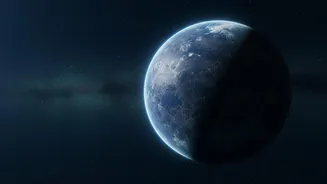
The term 'water vapour worlds' isn't a strict scientific classification, but it captures the excitement around a diverse group of planets where JWST has detected H2O. These aren't necessarily Earth-like planets. Some are 'hot Jupiters' or 'fluffy' Neptune-like planets, such as WASP-107b, where scientists found water vapour alongside surprising discoveries like sand clouds. Others are candidates for being 'Hycean' worlds—a theoretical class of planet covered in a deep liquid water ocean with a hydrogen-rich atmosphere. These planets are considered prime targets in the search for life because their extensive atmospheres are easier for JWST to observe.
Webb's Groundbreaking Discoveries
JWST has already delivered several landmark findings. On the exoplanet WASP-39b, a gas giant about 700 light-years away, the telescope made the first-ever detection of semi-heavy water in an exoplanet's atmosphere. This provides clues about how the planet formed and migrated over time. On another planet, the rocky super-Earth GJ 486 b, a signal almost certainly due to water was detected. However, scientists are still working to determine if the water is from a planetary atmosphere or from cool spots on the host star itself. These findings show the incredible power of the telescope, but also the caution required in interpreting the data.
A Closer Look at K2-18 b
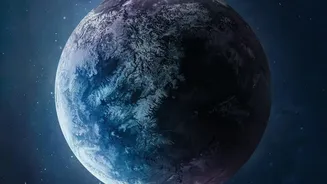
One of the most intriguing targets is K2-18 b, an exoplanet 8.6 times more massive than Earth that orbits within its star's habitable zone. Observations by JWST confirmed the presence of carbon-bearing molecules like methane and carbon dioxide, which supports the theory that it could be a Hycean world with a water ocean. Initial observations also provided a tantalising—though not yet confirmed—hint of dimethyl sulfide (DMS), a molecule that on Earth is overwhelmingly produced by life, primarily marine phytoplankton. Follow-up studies have urged caution, with some analyses not finding conclusive evidence for DMS, highlighting the complex and careful process of verifying such a profound discovery.
More Than Just Water
Finding water is a critical milestone, but it's just one piece of the puzzle. The ultimate goal is to find biosignatures—combinations of molecules that strongly suggest the presence of life. The abundance of methane and carbon dioxide, coupled with a lack of ammonia on K2-18 b, is what makes it a compelling candidate. The potential detection of DMS is so exciting because it's a specific biosignature. Spectrum analysis tells us not just what is present, but in what quantities. This complete picture is crucial for distinguishing a world that is merely wet from one that might actually be alive.